The 40-Gallon Tank in Your Basement Is a Decision
Most homeowners never choose their water heater. It came with the house, it rumbles in the basement or garage, and the first time anyone thinks about it is the morning the shower runs cold. But a water heater is the second-largest energy consumer in the average home — about 18 percent of the energy bill, behind only heating and cooling — and replacing it is one of the few purchases where the math genuinely favors doing your homework. The choice comes down to two fundamentally different machines: the storage tank, which keeps 40 to 80 gallons of water hot around the clock, and the tankless unit, which heats water on demand as it flows through.
Both have real advantages, both have real drawbacks, and the right answer depends on your fuel type, your hot-water habits, your climate, and how long you plan to stay in the house. This article compares them honestly: how each technology works, what each costs to buy and install, what each costs to run, how long each lasts, and how to calculate the payback period for your own household.
How Tank Water Heaters Work
A storage-tank water heater is beautifully simple: an insulated steel tank holds a large volume of water, a gas burner or electric elements heat it to a set temperature (typically 120°F), and a thermostat fires the burner or elements whenever the temperature drops. Standby loss — heat escaping through the tank walls and up the flue between uses — is the technology’s inherent inefficiency, and it is why tanks run even when nobody is home. Modern tanks fight this with thicker foam insulation, heat-trap nipples, and more efficient burners, but a tank still spends energy maintaining temperature 24 hours a day.
Tanks are sized by capacity and by first-hour rating (how much hot water the unit can deliver in its first hour of use). A 40- or 50-gallon gas tank suits most two- to three-bathroom homes; electric tanks recover more slowly, so they often need a size bump. The strengths of the tank are its low purchase price, its simple installation (a replacement typically drops into the existing footprint in a few hours), its tolerance for hard water and high demand, and the fact that every plumber in the country knows how to service one. Its weaknesses are standby energy loss, a finite supply (run the tank dry and you wait 30 to 60 minutes for recovery), and the failure mode: a tank that rusts through floods the floor, which is why tanks live in basements, garages, and drain pans.
How Tankless Water Heaters Work
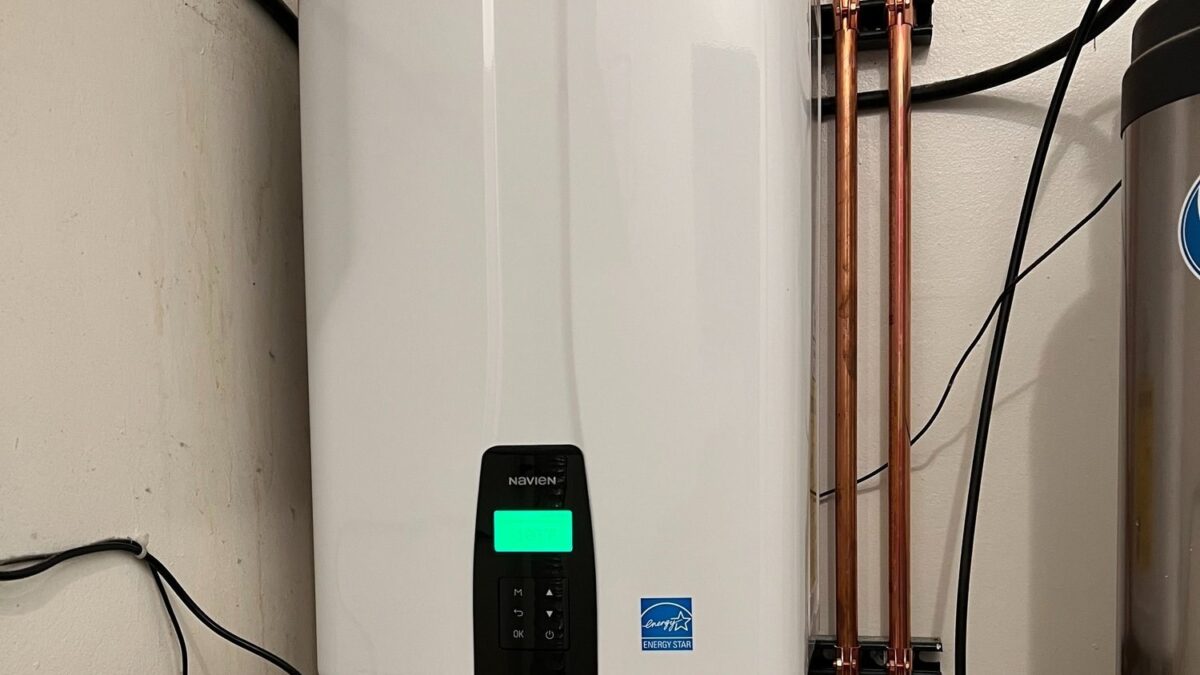
A tankless (on-demand) water heater has no reservoir. When you open a hot tap, a flow sensor fires a powerful gas burner or electric elements, and water heats as it passes through a heat exchanger — reaching full temperature in seconds. Close the tap and the unit shuts off. There is no standby loss because there is no stored hot water, which is the entire efficiency argument in one sentence.
But “heats instantly” needs a qualifier: the unit still has to heat the water, which means it is limited by flow rate, measured in gallons per minute (GPM), and by temperature rise — how much it must raise the incoming water’s temperature. A gas tankless unit delivering 8 to 10 GPM handles two simultaneous showers in a warm climate; in a cold climate, where groundwater arrives at 40°F and must be raised to 120°F, the same unit’s effective output drops sharply, and it may struggle with two showers at once. Sizing a tankless unit means calculating your peak simultaneous demand and your winter groundwater temperature — get either wrong and the system underperforms exactly when you need it most. Electric tankless units are worse on this front: they need enormous electrical service (often 100 to 150 amps for a whole-house unit), which many homes cannot supply without a panel upgrade.
Purchase and Installation Costs
This is where the comparison gets stark. A standard 50-gallon gas tank costs $600 to $1,200 for the unit, and a like-for-like replacement installation runs $900 to $1,800 total, depending on region, code upgrades (expansion tanks and earthquake strapping are now required in many areas), and disposal of the old unit. Electric tanks are cheaper to buy ($500 to $1,000) and simpler to install, with total replacement costs of $800 to $1,500. High-efficiency condensing tanks and heat-pump water heaters cost more — heat-pump units run $1,500 to $2,500 before installation — but we will treat those as upgrades within the tank family.
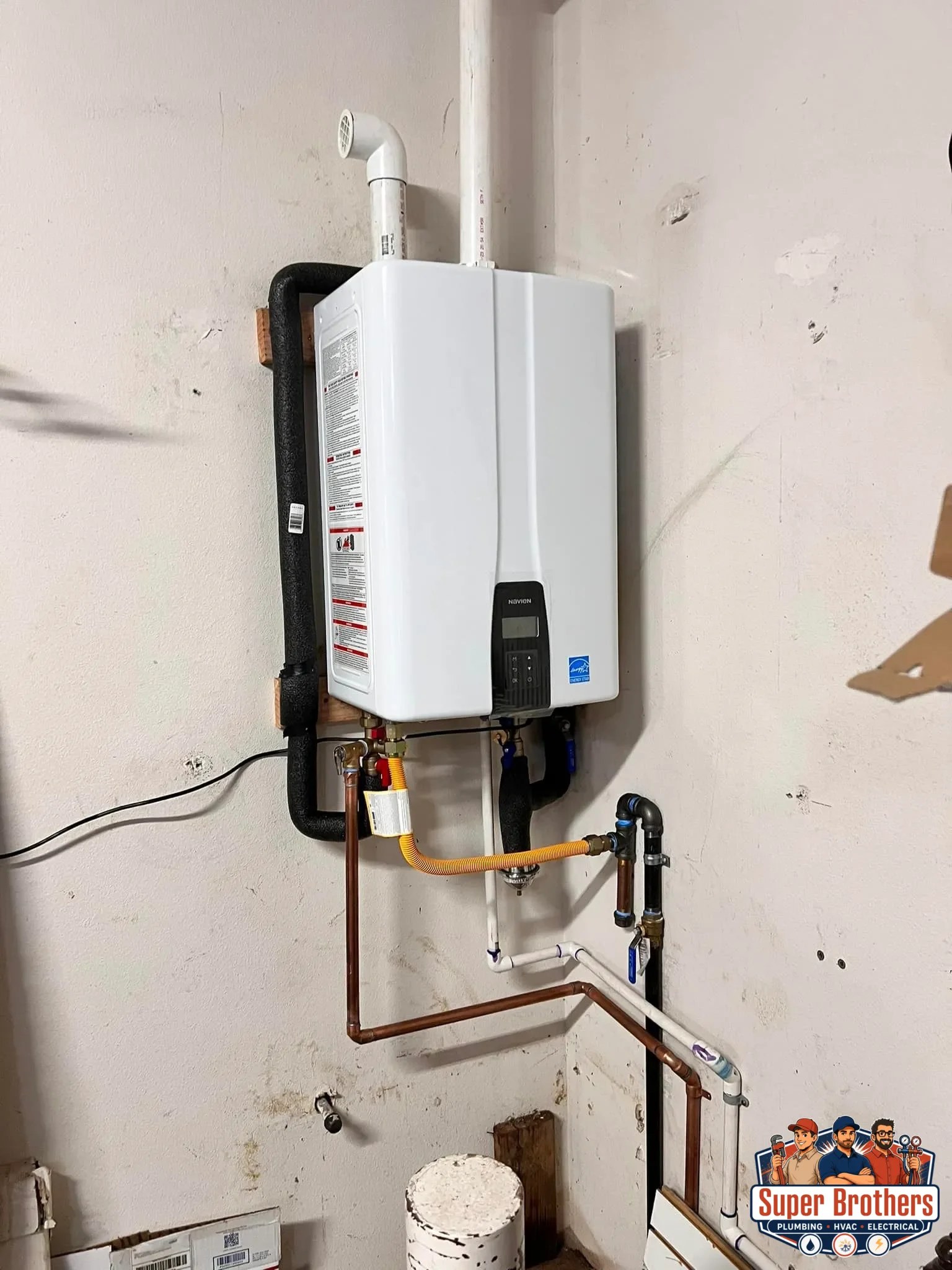
Tankless units invert the ratio. A quality gas condensing tankless unit costs $1,000 to $2,500 for the hardware, but installation is where the real money goes: $2,500 to $5,000 all-in is typical, and complex retrofits can exceed $6,000. Why so much? A tankless gas unit needs a larger gas line than the tank it replaces (a 199,000-BTU tankless burner demands far more gas than a 40,000-BTU tank burner), stainless-steel venting instead of the old atmospheric flue, often a new 120-volt circuit for the electronics and freeze protection, and sometimes a water softener or scale filter. Electric tankless is cheaper to install if the panel can handle it, but the panel upgrade many homes need can add $1,500 to $3,000 on its own. The honest rule of thumb: a tankless retrofit costs roughly two to three times a tank replacement.
Operating Costs and Energy Savings
The Department of Energy’s figures are the standard reference: for homes using 41 gallons or less of hot water daily, tankless units are 24 to 34 percent more energy-efficient than tanks; for homes using around 86 gallons daily, the advantage narrows to 8 to 14 percent. The logic is intuitive — the more hot water you use, the less standby loss matters relative to total consumption. A small household that uses little hot water saves the most with tankless; a large family running back-to-back showers and laundry all day saves the least, proportionally.
Translate that to dollars. A typical gas tank costs about $300 to $450 a year to run; a comparable tankless, $200 to $320 — a saving of roughly $100 a year for an average household, more for gas than for electric, more in expensive-energy states than cheap ones. Electric tanks cost $450 to $600 a year to run in many markets, and electric tankless saves less because electric tankless units are less efficient relative to their fuel than gas tankless is to gas tanks. Heat-pump water heaters — the dark horse of this comparison — cut electric water-heating costs by 60 percent or more, often beating tankless on operating cost while costing less to install. If your home is all-electric and you are chasing efficiency, the heat-pump tank deserves serious consideration before tankless.
Lifespan, Maintenance, and Failure Modes
Durability is tankless’s strongest argument after efficiency. A storage tank lasts 8 to 12 years — the steel tank eventually succumbs to corrosion from the inside, and the glass lining and anode rod only slow that down. A tankless heat exchanger lasts 20 years or more with maintenance, roughly twice the tank’s life. Over a 24-year horizon, you might buy three tanks or one tankless unit, which closes much of the purchase-price gap.
The maintenance caveat is real, though, and it surprises buyers. Tankless units in hard-water areas need annual descaling — a flush with vinegar or a descaling solution through the heat exchanger — or scale buildup will throttle performance and void the warranty. Tanks need maintenance too (annual flushing and anode-rod inspection every few years), but a neglected tank limps along for years, while a neglected tankless unit in hard water can fail in five. Budget $150 to $250 a year for professional tankless maintenance, or learn the 45-minute DIY flush. And remember the failure modes: a tank fails by leaking — potentially dozens of gallons on the floor. A tankless unit fails by not heating, which is inconvenient but not destructive. For finished basements, that difference matters.
The Payback Calculation
Now the central question: does tankless pay for itself? Work the numbers for a typical case. Suppose a tank replacement costs $1,400 all-in and a tankless retrofit costs $4,000 — a $2,600 premium. Annual energy savings of $100 a year give a simple payback of 26 years, which exceeds even the tankless unit’s lifespan. That looks terrible. But change the assumptions and the answer changes: a household with expensive natural gas saving $180 a year pays back in about 14 years, inside the unit’s life. Factor in the avoided second tank replacement (you would have bought a second $1,400 tank around year 10) and the lifetime economics tilt further toward tankless.
Rebates and tax credits shift the math more than anything. Federal energy-efficiency tax credits have covered 30 percent of heat-pump water heater costs in recent years, and many utilities offer $200 to $750 rebates for high-efficiency water heaters, tankless included. A $4,000 tankless install with a $500 utility rebate and a 30-percent credit (where applicable) can drop near the cost of a premium tank replacement — at which point the efficiency savings are pure upside. Check current federal credits and your utility’s rebate catalog before deciding; the programs change year to year, and they can move the decision by themselves.
The honest payback summary: tankless rarely pays for itself on energy savings alone in an average home. It pays when you value the other things it buys — endless hot water, twenty-year lifespan, wall-mount space savings (a tankless unit is the size of a suitcase), and no flood risk — or when rebates collapse the upfront premium. If none of those matter to you and your tank died on a Tuesday, a quality tank replacement is the rational economic choice, and there is no shame in it.
Fuel Type Changes the Entire Equation
The tank-versus-tankless debate cannot be separated from the fuel question, because fuel determines both the savings and the feasibility. Natural gas is the sweet spot for tankless: gas is cheap per BTU in most regions, gas tankless units are the most efficient of their kind, and the efficiency gap between a gas tank and a gas tankless is the widest in the industry. If your home already has a gas line to the water heater location, tankless is at its most attractive — and the gas-line upsizing, while real, is a known quantity.
Electricity flips the script. Electric tanks are cheap and simple, and the electric alternative to a standard tank is not really electric tankless — it is the heat-pump water heater, which uses a fraction of the electricity by moving heat rather than making it. A heat-pump tank costs $1,500 to $2,500 plus installation, uses about 60 percent less electricity than a standard electric tank, and often qualifies for the largest rebates. Electric tankless, by contrast, demands so much instantaneous current that many homes need a service upgrade, and it saves less relative to an electric tank than gas tankless saves relative to a gas tank. For all-electric homes, the short list is: heat-pump tank first, standard electric tank second, electric tankless only if you have a specific reason.
Propane sits in the middle: it works with gas tankless units, but propane costs roughly two to three times as much per BTU as natural gas, which stretches the payback period considerably. And in cold climates, remember the temperature-rise penalty — a tankless unit in Minnesota works much harder than the same unit in Arizona, and sizing must use the coldest incoming water temperature, not the average. Fuel, climate, and demand together determine the answer; anyone selling you a unit without asking about all three is selling, not advising.
Which One Should You Buy?
Choose a storage tank if: your budget is tight, your household uses a lot of hot water simultaneously (tankless sizing gets difficult and expensive), your gas line and venting would need major upgrades, your water is very hard and you will not maintain a descaling schedule, or you plan to sell within a few years (buyers do not pay a premium for tankless). Within the tank family, spend the extra for a heat-pump model if you are all-electric — it is the efficiency champion of the tank world.
Choose tankless if: you want endless hot water (large soaking tubs, back-to-back showers, teenagers), you are staying in the home long enough to amortize the cost, your gas infrastructure can support it without heroic upgrades, space is tight (tankless frees a closet or a corner of the garage), or the basement below the heater is finished and you fear tank leaks. Choose a condensing gas unit over non-condensing — the efficiency difference (around 0.95 vs 0.82 energy factor) is worth the modest premium, and condensing units vent with PVC instead of stainless steel, which simplifies installation.
Either way, size it right. An undersized tank means cold showers; an undersized tankless means lukewarm showers at low flow and cold ones at high flow. For tanks, match the first-hour rating to your peak hour. For tankless, add up the GPM of fixtures you will run simultaneously (a shower is 2 to 2.5 GPM, a dishwasher 1.5, a washing machine 2) and check the unit’s output at your winter groundwater temperature, not the headline rating at a mild 50-degree rise. A plumber who sizes by the old tank’s gallonage instead of by demand is guessing — make them do the arithmetic.
Installation Day: What to Expect
A tank replacement is a half-day job: drain and haul the old unit, set the new one, connect water, gas or electric, and venting, bring the installation up to current code (expansion tank, drip pan with drain, updated shutoff valves), and test. A tankless retrofit is a full day or two: gas-line upsizing, new venting routed to an exterior wall, condensate drain for condensing units, electrical circuit, water treatment if needed, and commissioning — including setting the output temperature (120°F is the safe standard; 140°F kills legionella concerns but scalds, so 120°F plus a mixing valve is the common compromise) and walking you through the descaling procedure.
Whichever you choose, three details separate good installs from bad ones: a full-port ball valve and a flush kit (isolation valves) on a tankless unit so descaling is possible without disassembly; an expansion tank on any closed plumbing system (required by code in most areas now, and its absence voids some warranties); and a drain pan under any tank located where a leak would cause damage, plumbed to a floor drain. These cost a plumber almost nothing to add during installation and a fortune to add later. Ask for them by name.
The water heater is one of the few home systems where the cheapest option is sometimes the smartest one and the premium option is sometimes worth every penny — it all depends on your fuel, your habits, and your horizon. Run the payback numbers with your actual energy rates, check the rebates before you decide, and size whatever you buy for the coldest morning of the year. Do that, and the shower will never run cold on your watch.
This article was produced with the assistance of AI.