Two Design Traditions, One Shared Instinct
On paper, Japan and Scandinavia have little in common. One is an island nation with a thousand-year-old craft tradition; the other is a cluster of northern countries shaped by long winters and democratic design movements. Yet their interiors rhyme. Both prize simplicity over ornament, natural materials over synthetic ones, craftsmanship over mass production, and a certain quietness — rooms that lower your heart rate when you walk in. Japandi is the name given to the deliberate fusion of these two traditions: Japanese minimalism’s restraint and wabi-sabi philosophy blended with Scandinavian design’s warmth, functionality, and livability. The result is a style that has quietly become one of the most influential interior movements of the decade.
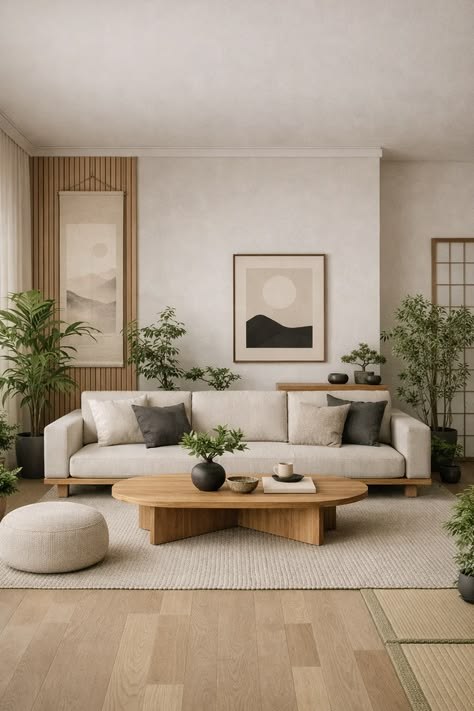
Japandi is not a product category and not a trend with an expiration date. It is a set of principles — about what a room contains, what it is made of, and how it feels — that happens to answer a very modern craving: for homes that are calm without being cold, minimal without being empty, and beautiful without shouting. This article explains where Japandi comes from, what defines it, how its two parent styles differ and complement each other, and how to bring it into your own home without turning the place into a showroom.
Where the Two Styles Come From
Scandinavian design, as the world knows it, crystallized in the 1950s: functional, democratic, light-filled interiors built around pale woods, clean lines, and the concept of hygge — the Danish idea of coziness as a life philosophy. It was design for long dark winters: bright rooms, warm textiles, furniture that invited you to sit down. Japanese aesthetics took a different path to a similar destination. The traditional Japanese interior — tatami mats, shoji screens, low furniture, a single alcove (tokonoma) displaying one perfect object — is built on principles of emptiness as a positive value, natural materials, and wabi-sabi: the appreciation of imperfection, impermanence, and the beauty of things that show their age and their making.
The fusion happened gradually and then suddenly. Japanese designers had admired Scandinavian craft since the mid-20th century; Scandinavian designers, in turn, found in Japanese interiors a deeper version of their own minimalism. By the late 2010s, the blend had a name and a momentum, accelerated by a cultural moment that prized decluttering, mindfulness, and homes that doubled as sanctuaries during long stretches of remote work. Japandi stuck because it is not really a new invention — it is two old wisdoms recognizing each other.
The Japandi Palette: Color, Material, and Light
Color in Japandi is restrained but not monochrome. The base is neutral: warm whites, soft beiges, light grays, the pale tones of birch and ash. Against this, the style layers deeper, earthier accents — charcoal, muted clay, sage, the dark brown of walnut, the near-black of charred wood (shou sugi ban, the Japanese technique of preserving timber by charring it). The contrast between light and dark is essential: Scandinavian design alone can drift toward all-white sterility; Japanese influence brings in the shadows, the darker woods, the sense that a room needs depth as well as light.
Materials are the soul of the style. Wood dominates — oak, ash, walnut, bamboo — left with visible grain and a matte or oiled finish rather than high-gloss lacquer. Stone, clay, and ceramics appear in their honest forms. Textiles are natural: linen, wool, cotton, paper. What you will not find is chrome, glossy plastic, or anything that looks machine-perfect; the Japandi surface should invite touch and show the hand of its maker. Even the light is treated as a material: soft, diffused, warm (2700K to 3000K), coming from paper lanterns, low-shaded lamps, and candles as much as from ceiling fixtures. Harsh overhead lighting is the enemy of the style — if your room has a single bright ceiling light, you have already lost the mood.
Furniture: Low, Crafted, and Fewer Pieces
Japandi furniture borrows the Japanese love of low profiles and the Scandinavian love of honest joinery. Sofas sit lower than average, often on short wooden legs or directly on a low platform; coffee tables are low and substantial; beds are platform-style, sometimes just a mattress on a low wooden frame. The silhouette is clean and rectilinear — no ornate carving, no curved excess — but the wood is allowed to be wood: visible grain, natural edges, joinery you can see and admire.
The deeper rule is quantity. A Japandi living room might contain a sofa, one or two chairs, a low table, a floor lamp, and a single plant — and that is the whole room. Every piece has to earn its place, which means every piece should be good: a well-made oak chair beats three mediocre ones. This is where the style quietly enforces quality over quantity, and where it saves money in the long run — buying half as much furniture, but buying it well. The Japanese principle at work is ma, the concept of negative space as an active design element: the empty floor between the furniture is not wasted space, it is part of the composition.
When shopping, look for the crossover pieces that both traditions claim: the low wooden bench that works as seating, a table, or a display surface; the paper-shaded floor lamp; the simple armchair in bent wood and wool. Vintage Scandinavian pieces and handcrafted Japanese-inspired furniture sit naturally side by side, which makes Japandi unusually friendly to secondhand and antique hunting — a 1960s Danish teak sideboard and a handmade ceramic vase are more authentically Japandi than a matching set from a single retailer.
Wabi-Sabi: The Philosophy of Imperfection
The most misunderstood element of Japandi is wabi-sabi, and it is worth getting right because it is the difference between the style and mere beige minimalism. Wabi-sabi finds beauty in imperfection, transience, and incompleteness: the handmade bowl that is slightly asymmetrical, the wooden table that has acquired scratches and a patina over twenty years, the linen curtain that wrinkles. It is the opposite of the showroom aesthetic, where everything is new and nothing may be touched.
In practice, wabi-sabi gives you permission to live in your home. The dining table does not need coasters on every inch; the ceramic mug with the slightly uneven glaze is the good one, not the flawed one. It also changes how you shop: instead of replacing a scratched table, you oil it; instead of hiding wear, you let the materials age. Kintsugi — the Japanese art of repairing broken pottery with gold — is the famous emblem of the idea, but the everyday version is simpler: choose materials that age gracefully (solid wood, natural stone, real linen) and let them. A Japandi home should look better in ten years than on the day it was finished, which is a rare promise in interior design.
Room by Room: Putting Japandi to Work
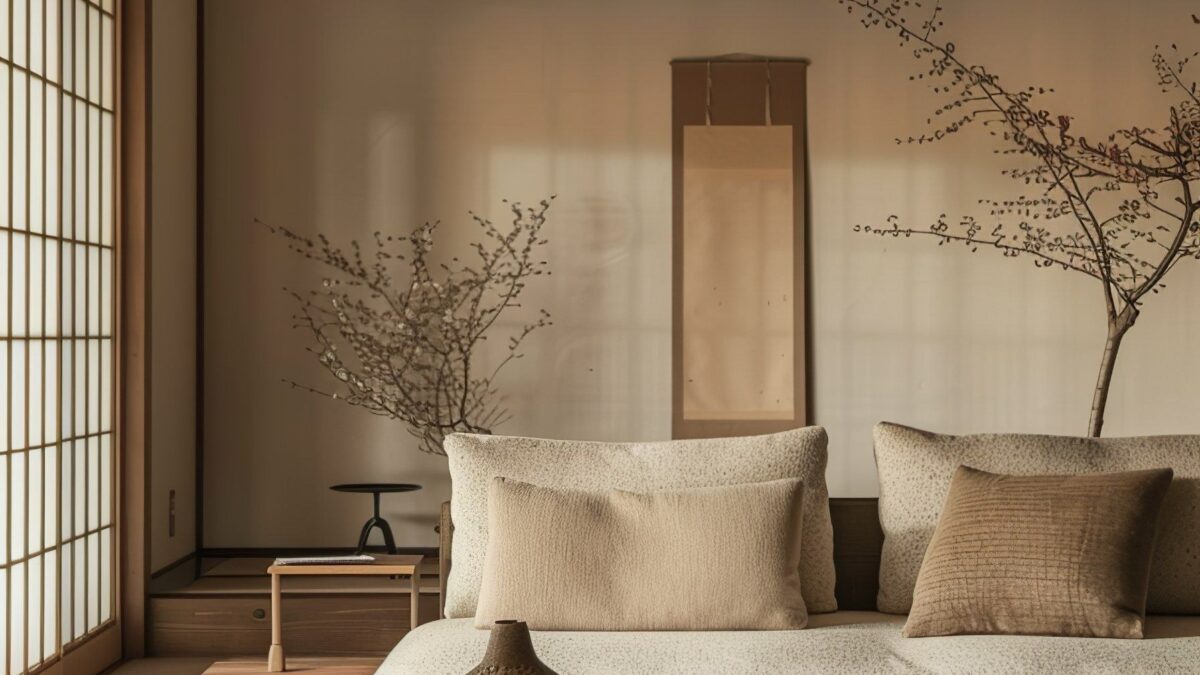
In the living room, start by subtracting. Remove everything that does not serve comfort or beauty, then arrange what remains with generous space between pieces. Anchor the room with a low-profile sofa in a natural fabric, add a wooden coffee table with visible grain, one statement plant (a fiddle-leaf fig, an olive tree, or a sculptural branch in a ceramic vase), and lighting at three heights — a paper floor lamp, a table lamp, candles. Keep surfaces mostly clear: one book, one bowl, one object with a story.
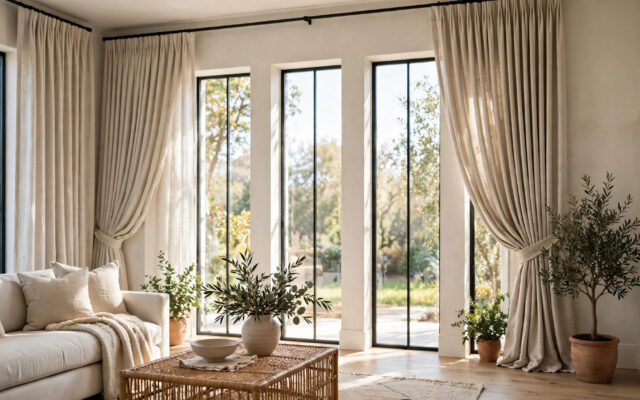
In the bedroom, Japandi is at its most natural. A low platform bed with linen bedding in white, oatmeal, or soft gray; a single wooden nightstand or a small stool; no headboard clutter, no gallery wall of ten frames — one piece of art, or none. Curtains in natural linen that filter light rather than block it. The bedroom should be the calmest room in the house, and Japandi’s restraint does the work for you.
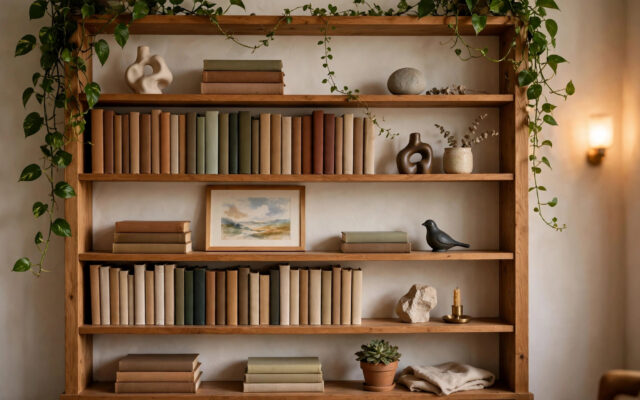
In the kitchen and dining area, the style translates to open shelving with a few beautiful objects rather than crowded cabinets, wooden or stone surfaces, handmade ceramics in daily use (not stored for special occasions), and a dining table in solid wood that shows its grain. Bathrooms get the spa treatment naturally: stone or wood-look tile, a wooden bath mat or stool, eucalyptus in a vase, and clutter-free counters with everything stored in natural-fiber baskets or simple wooden boxes.
Japandi vs Minimalism vs Scandinavian: Knowing the Difference
People confuse these constantly, so here is the clean distinction. Pure minimalism is about reduction as an aesthetic — often stark, sometimes cold, occasionally uncomfortable to live in. Scandinavian design is about light, comfort, and democratic function — warm and livable, but it can lean bright and busy when layered with too many textiles and pale objects. Japanese design is about restraint, ritual, and emptiness — profound, but sometimes austere for Western daily life.
Japandi takes the warmth and livability of Scandinavian design and tempers its brightness with Japanese depth and shadow; it takes the restraint of Japanese design and softens its austerity with Scandinavian coziness. The practical test: a minimalist room might have white walls, a white sofa, and nothing else. A Scandinavian room might have white walls, a gray sofa, five cushions, three throws, and a sheepskin. A Japandi room has warm-white walls, a low oatmeal sofa, one dark-wood table, a paper lamp, and a single ceramic vase — warm, but edited. If your room feels cold, add Scandinavian warmth (textiles, a plant, warmer light). If it feels cluttered, add Japanese subtraction.
The Role of Craft and Handmade Objects
Because Japandi rooms contain so few objects, each one carries unusual weight — which is why the style leans so hard toward the handmade. A hand-thrown ceramic vase, a hand-woven textile, a basket with visible weave: these carry the irregularities and the human trace that the style’s philosophy celebrates. You do not need a house full of artisan pieces; the principle works at small scale. Replace a mass-produced vase with one from a local potter. Choose a wooden bowl with visible tool marks over a perfect molded one. Hang one textile made by a human hand rather than three printed cushions.
This is also where the two parent traditions reinforce each other most beautifully. Scandinavian design has its own deep craft heritage — think of the bentwood chairs, the hand-loomed rugs, the ceramics studios of mid-century Denmark and Sweden — and Japanese craft traditions are among the oldest continuous ones on earth. A room that pairs a vintage Danish teak bowl with a Japanese stoneware cup is not mixing styles; it is speaking the shared language underneath both. And there is a practical dividend: handmade, well-made objects last. The $80 hand-thrown mug outlives five $12 mugs, which makes craft the economical choice over time, not just the aesthetic one.
Sustainability: Why Japandi Is Built to Last
Japandi’s sustainability credentials are structural, not decorative. A style built on buying less, buying well, and keeping things for decades is inherently low-waste — it is the opposite of fast furniture and seasonal redecorating. Solid wood can be refinished; natural fibers biodegrade; a well-made chair gets reupholstered rather than replaced. The style’s preference for secondhand and vintage pieces keeps furniture in circulation instead of in landfill, and its neutral palette means a room does not need repainting or re-styling when trends shift — the same warm-white walls work for decades.
The materials themselves tend toward the low-impact: bamboo and other fast-growing woods, natural linens and wools, clay and stone, finishes based on oil and wax rather than plastic lacquer. None of this requires a sustainability lecture to appreciate — it follows from the aesthetic. When a style’s idea of luxury is a single perfect wooden table that will outlive its owner, waste is simply not part of the program. In an era of disposable interiors, Japandi’s quietest radicalism may be its insistence that a room should be finished once, beautifully, and then lived in for a very long time.
Common Mistakes and How to Avoid Them
- Beige-on-beige flatness. The most common Japandi failure is a room that is all light neutrals with no contrast — it reads as bland, not calm. The fix is the dark accents the Japanese side brings: a walnut table, charcoal cushions, black-framed art, charred-wood accessories. Contrast is what makes the neutrals glow.
- Too empty. Subtraction is a principle, not a contest. A room with one chair and nothing else is not Japandi, it is unfurnished. The goal is enough — enough seating, enough light, enough texture — arranged with space to breathe.
- Fake natural materials. Plastic “wood,” printed “stone,” and polyester “linen” defeat the entire philosophy, which is about honest materials aging honestly. If the budget does not stretch to solid wood everywhere, use less of it rather than faking it — a single solid-oak bench beats a room of laminate.
- Matching sets. Japandi is collected, not decorated. A sofa, loveseat, and chair in the same fabric from the same store reads as a showroom. Mix a vintage wooden piece, a contemporary linen sofa, and a handmade ceramic — the slight tension between pieces is the style.
- Forgetting function. Scandinavian design insists that beautiful things work. If the low coffee table is unusable, the paper lamp gives no light, or the beautiful chair is agony to sit in, the style has curdled into theater. Comfort is a design requirement, not a compromise.
Bringing Japandi Home on a Real Budget
You do not need to gut the house. Start with subtraction — remove half the decorative objects from one room and live with it for a week; most people are shocked how much calmer the room feels, and it costs nothing. Then address light: replace cool-white bulbs with warm 2700K ones, add a paper-shaded lamp, and put the overhead on a dimmer. These three moves transform a room’s mood for under $150.
Next, introduce one honest material: a solid-wood side table from a secondhand store, linen curtains to replace synthetics, a handmade ceramic vase from a local potter. One real thing in a room changes how everything else reads. Paint is the cheapest transformation of all — a warm white or soft greige on the walls, and if you are brave, one wall or the ceiling in a deep charcoal or clay tone for the contrast the style needs. Add a single large plant, keep surfaces clear, and let the room be a little empty. Japandi is the rare style where doing less is the entire technique — and the budget version, done with discipline, is often more authentic than the expensive one.
Japandi is the rare style where doing less is the entire technique — and the budget version, done with discipline, is often more authentic than the expensive one. A calm room does not require a large budget; it requires clear decisions. Subtract first, add warmth second, invest in one honest material third, and let the empty space do the rest. The result is a home that feels considered rather than decorated — and that, more than any single piece of furniture, is what Japandi is really about.
This article was produced with the assistance of AI.