The entryway is the handshake of your home — the first thing guests see and the last thing you see every morning. Most entryways get zero design attention: a pile of shoes, keys on the counter, a bare bulb overhead. One weekend and roughly 150 dollars fixes all of it.
Define the Zone (Even Without Walls)
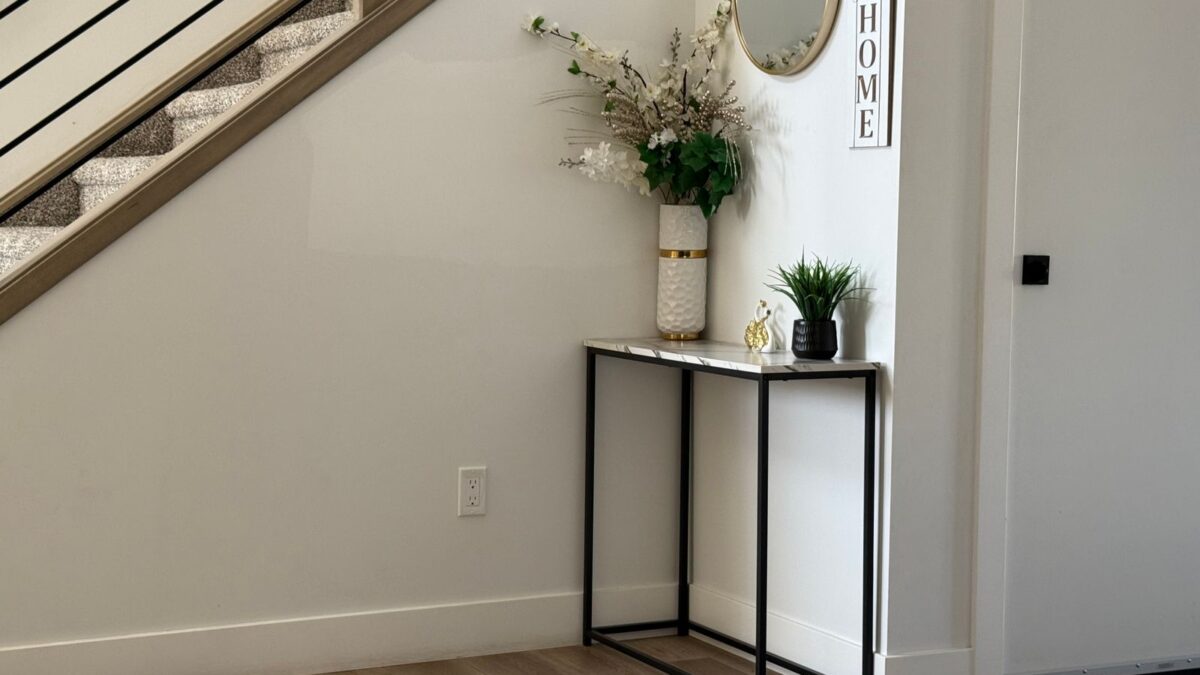
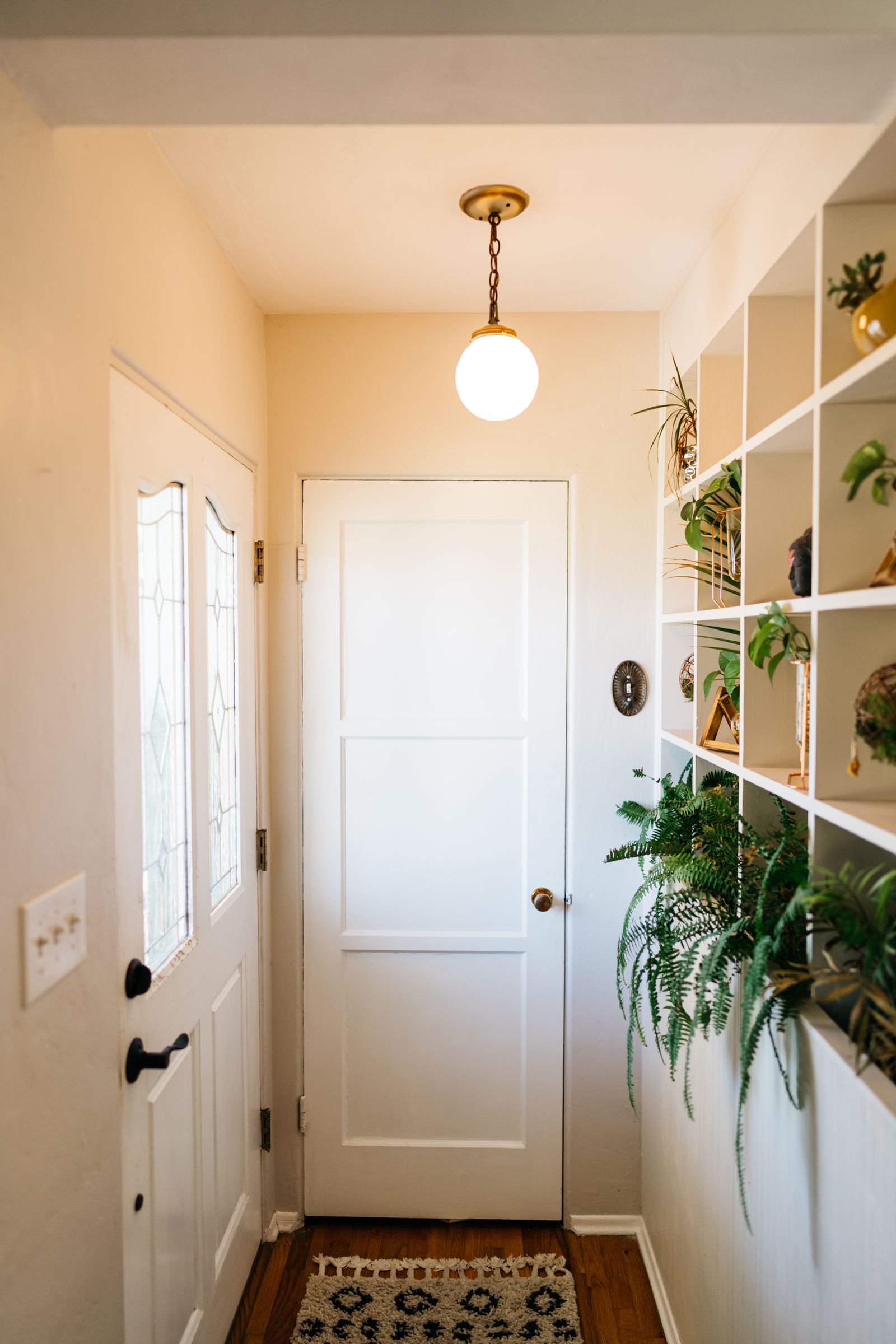
Many homes don’t have a true foyer — the front door opens straight into the living room. Define the entryway visually and the whole space reads as more intentional. A runner rug is the simplest boundary: a 2.5-by-7-foot runner in a durable low-pile material (indoor/outdoor rugs handle wet shoes and cost about 40 dollars) marks “this is the entry” without a single wall. If you have a few feet of wall beside the door, a narrow console table or wall-mounted shelf creates the functional anchor. In a true hallway entry, paint is the fastest transformation: one gallon covers it, and a saturated color — deep teal, warm charcoal, olive — makes a small entry feel like a designed moment rather than a pass-through. Because entryways take abuse (bags, shoes, wet umbrellas), use satin or semi-gloss paint that wipes clean.
The Drop Zone: Hooks, Bowls, and a Place to Sit
Every entryway needs to answer three questions: where do the keys go, where do the coats go, and where do I sit to put on shoes? A wall-mounted hook rail (about 25 dollars for a solid wood 5-hook rail) handles coats and bags — mount it into studs at 60 inches high, because a rail full of winter coats pulls with surprising force and drywall anchors will eventually give up. For keys and small items, a small tray or bowl on the console: the rule is one designated spot, always the same spot, and the “where are my keys” problem disappears. The seating piece depends on space: a storage bench (around 80 dollars, with a hinged top or cubbies) is the gold standard — seating plus hidden shoe storage in one footprint. In a tight entry, a single sturdy stool or even a wall-mounted fold-down seat works. Whatever you choose, keep the shoe situation to one row: a boot tray (about 20 dollars) corrals wet footwear and protects the floor, and a “one pair out per person” rule keeps the pile from returning by Tuesday.
Light It Like an Entrance, Not a Hallway
Entryway lighting is almost universally terrible — a single flush-mount doing nothing. If you have the ceiling height, a small pendant or lantern-style fixture (starting around 60 dollars) hung so the bottom sits 7 feet off the floor instantly signals “entrance.” No ceiling box to work with? A pair of plug-in wall sconces flanking a mirror, or a table lamp on the console, gives warm light at eye level where it flatters everyone walking in. Swap the bulb to 2700K warm white at minimum 800 lumens — entries need to feel bright and welcoming, not dim and cave-like. A motion-sensor bulb in the entry fixture (about 12 dollars) is a small luxury that pays off every time you come home with arms full of groceries: the light’s already on. And if your entry has no natural light at all, a large mirror opposite the door bounces what light exists and doubles the perceived space.
Paint the Door (Yes, the Front Door)
Nothing changes a home’s first impression like the front door color. From the inside, painting the interior face of the door takes one quart of paint and an afternoon — remove the hardware or tape it carefully, sand lightly with 120-grit, and apply two coats of exterior-grade enamel (satin or semi-gloss) even on the interior face, because doors take knocks. From the outside, a bold door color — classic red, deep navy, black, forest green — is the highest-ROI curb appeal move that exists. While you’re at it: replace the house numbers (modern 4-inch numbers, about 20 dollars for a set, mounted at eye level beside the door), swap a builder-grade door handle for one with some weight to it, and add a new doormat — a coir mat (about 25 dollars) actually scrapes shoes clean, unlike the thin decorative ones. These exterior touches take an hour and greet you before you even turn the key.
Storage That Hides the Daily Mess
The entryway accumulates the whole household’s transit items: mail, sunglasses, dog leash, reusable bags. Contain it or it spreads. A wall-mounted mail sorter or a single basket on the console labeled for nothing in particular becomes the mail’s home — sort it weekly, recycle the junk immediately. Baskets are the entryway’s best friend: one lidded basket per family member on a low shelf or inside the bench holds gloves, hats, and the random. For narrow entries, a tall, shallow shoe cabinet (about 70 dollars, 12 inches deep) holds 12-plus pairs behind closed doors and doubles as a console top. The principle: closed storage for the ugly-functional stuff, one open surface for the pretty stuff. An entry where everything has a door or a lid looks clean even when it’s full.
Style It in Fifteen Minutes
Once the functional pieces are in, the styling is quick. A round mirror above the console (24 to 30 inches diameter) is the classic entry move — it bounces light and gives a last look before leaving. One piece of art or a framed print at eye level on the remaining wall; a small plant that tolerates low light (snake plant, ZZ plant) in a decent pot; a candle or small lamp for evening warmth. Keep the console surface to three items max: the key tray, one decorative object, the plant or lamp. The “rule of three” with varied heights (low tray, medium plant, tall lamp or mirror above) is the whole formula. Step outside, come back in through the front door, and look with fresh eyes — that’s the view every guest gets, and it’s the one you’re designing for.
The $150 Breakdown
Here’s where the money goes for a complete transformation: runner rug ($40), hook rail ($25), boot tray ($20), key tray or bowl ($15), quart of door paint ($20), new house numbers ($20), coir doormat ($25). That’s $165 before tax, and every piece is doing functional work, not just decoration. Already own some of it? Put the savings into the one upgrade with the most daily impact — usually the lighting or the storage bench. The entryway is small, which is exactly why the budget works: a little money covers the whole room, and you’ll feel the difference every single time you walk through the door.
Tiny Entryway? Go Narrow and Vertical
If your “entryway” is a 3-foot stretch of wall beside the door, the standard advice still applies — it just gets narrower and taller. Swap the console table for a wall-mounted shelf 10 to 12 inches deep: it holds the key tray and a small plant without touching the floor, so shoes tuck underneath. A single row of hooks at 60 inches handles coats; add a second lower row at 40 inches for kids’ bags and dog leashes. The mirror goes above the shelf — even a 16-inch round mirror bounces light and gives the last-look check. A narrow boot tray (12 by 30 inches) lines up against the wall and holds two pairs of shoes without jutting into the walkway. The runner rug still works — just size it to the actual path, even if that’s only 2 by 4 feet. Total footprint: about 6 square feet of wall and a 2-foot strip of floor.
The vertical trick for micro-entries: use the full wall height. A tall, narrow shelf unit (12 inches deep, 72 inches tall) beside the door holds shoes on the bottom shelves, baskets for gloves and hats in the middle, and decor up top — it’s a closet, console, and display in one. Mount a motion-sensor LED puck under the top shelf and the whole unit glows when you walk in. In a truly door-to-wall entry with zero side wall, the back of the front door itself takes two sturdy hooks for the daily bag and keys, and a small wall-mounted folding shelf opposite gives you a landing spot. Small entries actually stay tidier than big ones — there’s simply no room for the overflow that turns foyers into junk zones.
Start Saturday morning with the rug and the hooks, paint the door while the light’s good, and style the console Sunday with coffee in hand. By Sunday evening, coming home will feel different — which is the entire point of an entryway.