
There’s a particular kind of regret that arrives about eighteen months into a car loan. The new-car smell is long gone, the first mysterious rattle has appeared, and the monthly payment — which felt manageable in the dealership’s finance office — has become a permanent, grinding fixture of your budget. You owe more than the car is worth, you’re paying interest on a depreciating asset, and you realize the car is driving your finances rather than the other way around. This is financing regret, and it’s one of the most common and most avoidable financial mistakes people make.
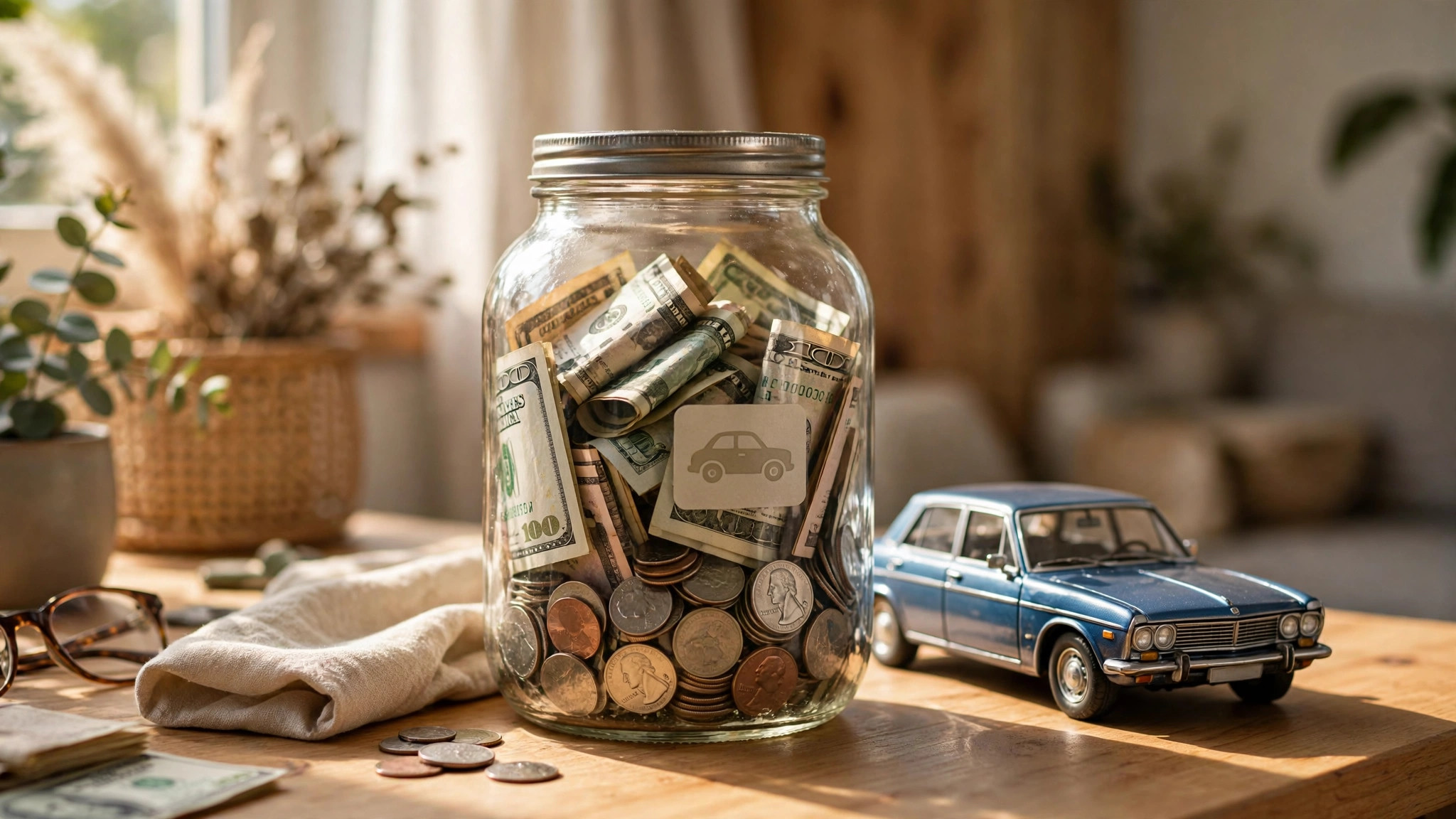
The alternative isn’t complicated, but it does require something the car industry works hard to prevent: patience. Saving for a car — buying with cash, or with a large down payment and a short loan — changes the entire economics of car ownership. You pay less (no interest, or much less of it), you negotiate better (cash buyers get better prices), you buy only as much car as you can actually afford (the savings target enforces honesty), and you never experience the special misery of being underwater on a rapidly depreciating asset.
This guide is the complete playbook: how to set a realistic car savings target, how to save systematically without derailing the rest of your finances, the math that shows what financing really costs, smart buying strategies for cash purchasers, and how to handle the situations — the dead car, the growing family — where waiting isn’t an option. Educational information, not financial advice — but the principles here have saved countless buyers tens of thousands of dollars.
The True Cost of Financing: What the Payment Hides
Dealerships sell monthly payments, not cars, and that’s the first thing to understand. “Only $389 a month!” sounds manageable; “$389 a month for 72 months at 8% interest on a $24,000 car” sounds like what it is: roughly $28,000 paid for a car priced at $24,000, which will be worth perhaps $12,000 when the loan ends. The longer the term, the worse the math — 84-month loans, now common, mean you’re paying interest for seven years on an asset that lost 20% of its value the day you drove it off the lot.
Run the comparison honestly. A $25,000 car financed at 7% for 60 months costs about $29,700 total — $4,700 in interest alone. Financed for 72 months, it’s over $30,700. And that’s before considering that financed buyers tend to buy more car: when the question is “can I afford the payment?” instead of “can I afford the car?”, people routinely buy 20–30% more vehicle. The payment framing doesn’t just cost interest — it inflates the purchase itself.
Then there’s depreciation’s cruel interaction with loans. New cars lose roughly 20% in the first year and 15% annually for several years after. With a small down payment and a long loan, you owe more than the car’s worth for years — “underwater” or “upside down.” If the car is totaled or you need to sell, you write a check for the difference. Cash buyers never face this. Large-down-payment buyers rarely do. This alone justifies the discipline of saving first.
Setting Your Target: How Much Car Can You Actually Afford?
The savings target enforces a honesty that financing avoids: you can only buy what you’ve actually saved. But “save up and see” is too vague — you need a number. The classic guidelines: the 20/4/10 rule — 20% down, finance no more than 4 years, and keep total car costs under 10% of gross income. If you’re saving to buy outright, adapt it: total car costs (payment-equivalent savings, insurance, fuel, maintenance) under 15% of take-home pay is a sustainable ceiling for most households.
Be specific about what you’re buying before you save for it. Research the actual market: the three-year-old Honda or Toyota that fits your needs, its real-world price in your area (not the MSRP — the out-the-door price including tax, title, and fees), plus a buffer for immediate needs (tires, a service, registration). A target like “$14,500 for a 3-year-old compact, all-in” beats “save for a car” because you can track progress against it — 40% funded, 70% funded — and progress is motivating.
And be honest about needs versus wants. The car that reliably gets you to work is a need; the trim package, the extra 80 horsepower, and the badge are wants. Nothing against wants — but fund them with eyes open. Many savers discover that the “need” costs $12,000 and the “want” costs $22,000, and the $10,000 gap represents a year of additional saving. Sometimes the want wins anyway. The point is that saving makes the trade-off visible, where financing hides it inside a monthly payment.
The Savings System: Making It Automatic and Untouchable
Car savings fail for the same reason all savings fail: they rely on willpower at the end of the month, competing with every other demand. The fix is automation and separation. Open a dedicated high-yield savings account — ideally at a different bank from your checking, so the money isn’t staring at you — label it “Car Fund,” and set up an automatic transfer on payday. Pay the car fund the way you’d pay a loan: non-negotiable, first, before discretionary spending.
How much per month? Work backward from your target and timeline: $15,000 in 24 months is $625/month; in 36 months, $417. If the monthly number is impossible, you have three honest levers: extend the timeline, lower the target (older car, fewer features), or increase income temporarily (the car fund is an excellent use for a side gig with a defined end date — “I’m driving weekends until the car is funded” is motivating in a way open-ended hustling isn’t).
Protect the fund ruthlessly. It’s not an emergency fund (keep that separate), not a vacation fund, not available for “borrowing.” The one exception: a genuine transportation emergency — your current car dies prematurely — in which case the fund does its job early, buying whatever reliable car it currently covers. That’s not failure; that’s the fund working as designed.
Where to Keep the Money While You Save
For timelines under three years, a high-yield savings account is the right vehicle — safe, liquid, earning modest interest. Don’t invest car savings in the stock market: the timeline is too short, and a 20% market dip the month before you buy is a catastrophe. For timelines of three to five years, a conservative mix (mostly high-yield savings, perhaps some short-term bonds) is defensible, but simplicity usually wins. The car’s purchase date is non-negotiable in a way retirement isn’t — capital preservation matters more than growth.
Speeding It Up: Finding the Money
Most people can fund a car faster than they think by treating the savings period as a focused sprint. Tactics that work: redirect an existing payment — if you just paid off any loan or subscription, route that exact amount to the car fund before lifestyle creep absorbs it. Sell the upgrade path — sell unused items, and consider whether your current car’s equity can bridge part of the gap. Bank the windfalls — tax refunds, bonuses, and gifts go straight to the car fund, no debate. Run a temporary spending freeze on your weakest category (dining out is the classic) and redirect the savings.
The most powerful accelerator is often driving the current car longer. Every additional year you keep a paid-off car is a year of “payments” you can save instead of spend. A car with 120,000 miles that runs reliably is a car-savings machine: no payment, lower insurance, and every month adds to the fund for its eventual replacement. The cheapest car is almost always the one you already own — maintain it well and let it fund its successor.
Buying Smart with Cash: The Negotiation Advantage
Cash buyers negotiate differently, and dealers know it. When you’re not financing through the dealership, the conversation simplifies to one number: the out-the-door price. No payment packing, no extended warranty folded into monthly payments, no interest-rate markup, no “let me talk to my manager” theater around financing terms. Get out-the-door quotes from multiple dealers in writing, and let them compete on the only number that matters.
Cash also unlocks the private market, where the best values live. Private sellers can’t offer financing, so their buyers are cash buyers — and private-party prices typically run 10–15% below dealer retail for equivalent cars. A pre-purchase inspection ($150–$200 at an independent mechanic) is non-negotiable for private purchases and cheap insurance against expensive mistakes. For dealer purchases, cash doesn’t always get a discount (dealers profit from financing), but it always gets transparency — and transparency is where buyers save money.
Timing helps too: shop at month-end or quarter-end when dealers chase volume bonuses, consider outgoing model years, and never negotiate while emotionally attached to a specific car on a specific lot. Your savings gave you the ultimate negotiating tool — the ability to walk away. Use it.
When You Can’t Wait: Minimizing Financing Damage
Sometimes the car dies before the fund is full, or a growing family can’t wait two years. If you must finance, minimize the damage: put down everything you’ve saved — a 40–50% down payment transforms the loan math, often halving the interest paid and eliminating underwater risk. Keep the term short — 36 to 48 months maximum; every additional year is mostly interest and depreciation risk. Secure financing before shopping — a pre-approved loan from your bank or credit union (which typically beats dealer rates) turns you into a cash-equivalent buyer at the dealership.
Never finance the extras. Extended warranties, paint protection, GAP insurance from the dealer — all cheaper elsewhere or unnecessary with a big down payment. And keep saving during the loan — redirect a portion of what would have been a longer loan’s payment into starting the next car fund. The goal is for this to be your last financed car: drive it long after the loan ends, banking the “payment” for its replacement.
The Upgrade Cycle Trap (and How Savers Escape It)
The car industry’s business model depends on the upgrade cycle: buy new, finance long, roll negative equity into the next loan, repeat forever. Each cycle extracts interest and depreciation while keeping you perpetually in debt. Savers break the cycle structurally: buy a 2–4-year-old car with cash (letting the first owner absorb the steepest depreciation), drive it for 6–8 years while saving for the next one, repeat. Over a lifetime, this pattern saves staggering amounts — easily six figures compared to serial new-car financing.
The used-car sweet spot deserves emphasis: a 3-year-old car has typically lost 35–45% of its value but retains 70%+ of its useful life, especially for reliable makes. It’s the best value in the automotive market, and it’s only available to buyers who can pay cash or arrange their own financing — which is to say, buyers who saved. Patience doesn’t just avoid interest; it buys you into the market’s best deals.
Note: This article is educational information about saving and buying strategies, not personalized financial advice. Vehicle prices, loan rates, and tax considerations vary; consider your own circumstances when making major purchase decisions.
Frequently Asked Questions
How much should I save for a car?
Q: How much money should I save before buying a car?
A: Enough to buy a reliable car that meets your needs outright, or at minimum a 20% down payment with total car costs under 10–15% of income. Research actual out-the-door prices (including tax, title, and fees) for the specific 2–4-year-old models you’re considering, add a buffer for immediate maintenance, and save to that concrete number. For most buyers, a $12,000–$18,000 target buys excellent reliable transportation in the used market.
Is it better to buy new or used with cash?
Q: If I’m paying cash, should I buy new or used?
A: Used — specifically 2–4 years old — is the value sweet spot: the first owner absorbed 35–45% depreciation, but 70%+ of the car’s useful life remains. A new car’s premium buys you warranty and certainty, which has value, but from a pure financial perspective, the slightly-used reliable car (Honda, Toyota, Mazda and similar) is extremely hard to beat. Get a pre-purchase inspection regardless.
How long will it take to save for a car?
Q: How long does it realistically take to save for a car?
A: Divide your target by your monthly savings: $15,000 at $500/month is 30 months; at $750/month, 20 months. Most disciplined savers fund a solid used car in 18–36 months. Accelerate by redirecting paid-off loan payments, banking windfalls, temporarily cutting your weakest spending category, and driving your current car as long as it’s reliable — every payment-free month is savings.
What if my car dies before I’ve saved enough?
Q: What if my current car dies before my car fund is full?
A: Use what you’ve saved as a large down payment (40–50% transforms the loan math), keep the term to 48 months maximum, get pre-approved financing from a bank or credit union before shopping, and buy the cheapest reliable car that meets your needs — not the car you were saving for. Then keep saving during the loan so this is your last financed car.
Should I keep saving for a car while paying off debt?
Q: Should I save for a car while I still have other debt?
A: Generally, attack high-interest debt first — paying 20% credit card interest while saving for a car is losing math. But if your current car is unreliable and its failure would threaten your income, building a modest car fund alongside minimum debt payments is prudent risk management. Once high-interest debt is gone, redirect those payments to the car fund.
Does paying cash really get a better price?
Q: Do cash buyers actually get better prices at dealerships?
A: Cash simplifies negotiation to a single out-the-door number and eliminates financing profit centers (rate markups, packed payments, financed extras) — which is where dealers often make their margin. You may not get a line-item “cash discount,” but you get transparency, and transparency saves money. Cash also unlocks private-party purchases, which typically run 10–15% below dealer retail.
What about 0% financing offers?
Q: What about 0% APR financing offers — isn’t that free money?
A: Genuine 0% offers (usually on new cars, for well-qualified buyers, often with a shorter term) can make sense mathematically — but read carefully. You often forfeit a cash rebate to get the 0% rate, and the “0%” applies to a new car at full price, which is depreciating fastest. Compare the total out-the-door cost of the 0% deal against a discounted price with outside financing or a used purchase; the 0% isn’t always the cheapest path.
Conclusion: Buy the Car, Not the Payment
The car industry has spent decades training buyers to think in monthly payments, because payment-thinking sells more car at higher margins. Saving for a car reverses the entire dynamic: you think in total cost, you negotiate on price, you buy only what you’ve earned the right to buy, and you keep the thousands that would have gone to interest. The wait is the hard part — 18 to 36 months of driving the old car while the fund grows — but the wait is also the mechanism. It’s what makes the purchase honest.
Start this month: pick your target car and its real out-the-door price, open the dedicated account, automate the transfer, and drive your current car like the savings machine it is. When you finally hand over payment in full and drive away with no lien, no payment book, and no regret, you’ll understand what the financing-weary learn too late: the best car loan is the one you never needed.