Your entryway is the only room in your house that every single guest experiences — and it’s the room most homeowners think about least. It’s where first impressions form in the first seven seconds, where the transition from the chaos of the outside world to the calm of home either happens gracefully or doesn’t happen at all. And yet in most homes, the entryway is an afterthought: a dumping ground for shoes, a graveyard of unopened mail, a dim corridor you rush through without looking.
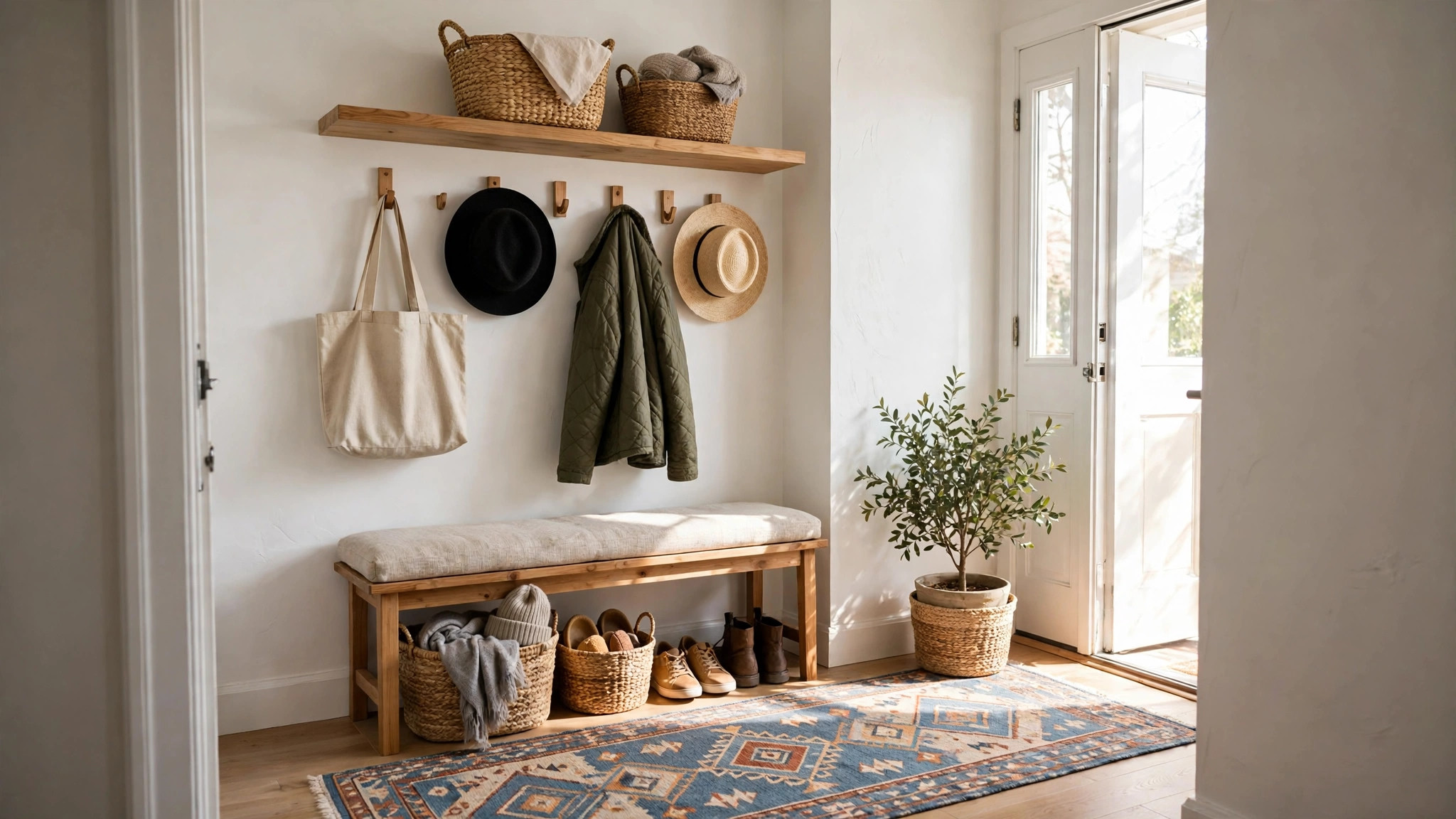
This is a missed opportunity of the highest order. A well-designed entryway does three jobs simultaneously: it welcomes guests with a clear sense of your home’s character, it organizes the daily churn of shoes, coats, keys, and bags so clutter never migrates into the living areas, and it sets the psychological tone — the exhale — of coming home. None of this requires a grand foyer. Some of the best entryways in the world are six feet of hallway executed brilliantly.
This guide covers entryway design from first principles: defining the space (even when there isn’t one), the functional zones every entry needs, furniture and storage that earn their footprint, lighting that flatters, style that sets the tone, and solutions for the hardest cases — tiny apartments, open-plan entries, and households with kids, pets, and glorious amounts of stuff.
Defining the Entryway (Even When You Don’t Have One)
Many homes — especially apartments and open-plan houses — have no architectural entryway at all. The front door opens directly into the living room, and the “entry” is a concept, not a place. The first design move is to create one visually, because undefined entries become clutter zones: without boundaries, shoes and bags spread until they colonize the nearest horizontal surface.
The tools for defining an entry without walls: a rug (the single most effective entry-definer — it says “this zone is the entry” more clearly than anything else), a console table or bench against the nearest wall, a light fixture that marks the zone (a pendant or flush-mount distinct from the living room’s lighting), and paint or wallpaper on the entry wall to distinguish it. Even two of these four create a legible entryway where none existed. The rug is non-negotiable — it’s the foundation everything else builds on.
For homes with a proper foyer or mudroom, the job is different: honor the architecture. Don’t fight a grand entry with tiny furniture (it looks lost) or cram a narrow hall with deep pieces (it blocks flow). Measure the space, note the traffic path from door to the rest of the house, and design around it — the walkway is sacred; everything else arranges itself around the walkway.
The Five Functional Zones Every Entryway Needs
Regardless of size, every entryway performs the same five functions. Design for all five and the space works; miss one and clutter finds the gap.
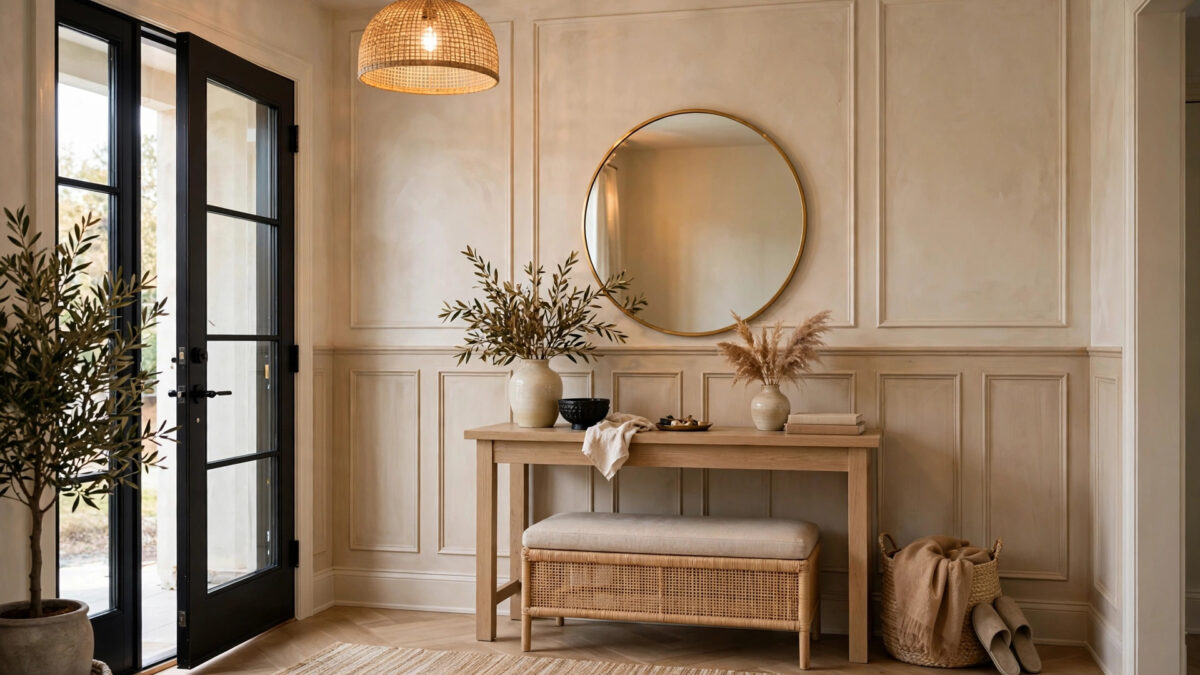
1. The landing strip. The surface where keys, wallet, phone, sunglasses, and mail land the second you walk in. A console table, a wall-mounted shelf, or even a beautiful tray on a bench — the key (pun intended) is that it’s right by the door, at a natural dropping height, and dedicated to the purpose. Households that establish a landing strip stop losing keys. It’s that simple.
2. Shoe management. Shoes are the number-one source of entryway chaos. The solution depends on volume: a couple needs a small bench with storage or a slim shoe cabinet; a family of five needs a serious system — cubbies, a tall cabinet, or a mudroom wall. The rule: every regularly-worn pair needs a designated home within arm’s reach of the door. Pairs without homes become floor. Enclosed storage (cabinets with doors) looks dramatically tidier than open racks for large collections.
3. Coat and bag storage. Hooks beat hangers for daily use — faster, more visible, more forgiving. A row of sturdy wall hooks handles coats, bags, and dog leashes; a coat closet (if you’re lucky enough to have one) should be ruthlessly edited to current-season daily items only, with off-season coats stored elsewhere. The entryway is prime real estate — it should hold what you use daily, not archive what you wore in 2019.
4. The mirror and the pause. A mirror near the door serves the last-look function (guests and residents both use it), bounces light into what is often a dim space, and visually doubles a small entry. Hang it at face height where the natural pause happens — beside the door, above the console. Full-length is ideal if space allows; even a modest round mirror transforms the wall.
5. Seating (if space allows). A bench or stool for putting on shoes is a small luxury with outsized daily impact — especially for kids, older family members, and boot season. Storage benches double the value: seating plus hidden shoe storage in one footprint. In truly tiny entries, a wall-mounted fold-down seat or a sturdy stool tucked under the console works.
Furniture That Earns Its Footprint
Entryway furniture must justify every inch, because inches are scarce. The workhorses: console tables (narrow — 10–14 inches deep — so they don’t block traffic; the landing strip plus display surface), storage benches (seating + shoe storage), slim shoe cabinets (tilt-out designs hold many pairs in 6 inches of depth), wall hooks and hook rails (vertical storage that uses zero floor space), and baskets (the universal clutter-tamer — one for gloves and hats, one for pet supplies, one for “goes upstairs”).
Scale ruthlessly. Measure your walkway: you need a minimum of 36 inches of clear passage (42+ is comfortable), and every furniture piece must respect it. In narrow halls, go vertical — tall narrow cabinets, stacked hooks, wall-mounted everything. In wide foyers, resist the urge to fill the space; a grand entry with one beautiful console, one statement mirror, and one great light fixture looks richer than the same space crammed with furniture.
Choose materials that forgive. Entryways take abuse — wet shoes, muddy paws, banged bags. Performance fabrics, sealed wood, metal, and washable rugs aren’t compromises; they’re the correct specification. The beautiful white linen bench is for the catalog; the beautiful wipeable bench is for your life.
Lighting: The Welcome Matters Most Here
Entryway lighting does emotional work no other room’s lighting does: it’s the first light guests see and the light that greets you every homecoming. It should be warm (2700K), welcoming, and — critically — on a level that flatters. Harsh overhead fluorescents in a foyer feel like a security checkpoint; a warm pendant or pair of sconces feels like an embrace.
The classic entryway formula: a statement fixture (pendant, chandelier, or distinctive flush-mount — scaled to the space; too-small fixtures are the most common entryway lighting mistake) plus one accent source (a small lamp on the console, a picture light over art, LED strip in a niche). Put them on a dimmer or smart control, and consider automation — a light that turns on as you arrive (smart switch on a schedule, or a motion sensor for the hallway) means you never walk into a dark house. For windowless entries, lighting matters doubly: it’s the only daylight the space gets, so make it generous and warm.
Style: Setting the Tone for the Whole Home
The entryway is your home’s thesis statement — it tells guests what to expect. It doesn’t need to match every room, but it should rhyme with them: the entry to a modern farmhouse shouldn’t look Victorian, and the entry to a minimalist apartment shouldn’t be maximalist. Pull one or two threads through — a wood tone, a metal finish, a color — that appear in both the entry and the main living spaces, and the home reads as cohesive.
Art and personality belong here disproportionately. A bold piece of art in the entry sets a confident tone; family photos create immediate warmth; a gallery wall up the stairwell turns circulation into exhibition. This is also the place for the objects that say who you are — the travel souvenir, the vintage find, the plant you’ve kept alive for a decade. Guests form impressions in seconds; give them something true to look at.
Color strategy: entries can handle more drama than any other small space, because nobody lingers in them. A moody dark wall, a bold wallpaper, a saturated color — all the choices that might overwhelm a bedroom feel electric in an entry. It’s the lowest-risk place in your home to be brave with color. And if the entry opens directly into the living area, use the entry’s bolder choice to make the living space’s calm feel intentional by contrast.
The Hard Cases: Tiny, Open-Plan, and High-Chaos Entries
The micro-entry (a wall, not a room): One wall is enough. Mount a floating shelf (landing strip), a row of hooks above it (coats and bags), a mirror, and a rug on the floor below. Four elements, zero floor footprint beyond the rug. Add a slim umbrella stand or a single basket for shoes. Done — it’s small, but it’s a complete entryway.
The open-plan entry (door opens into living room): Definition is everything — rug, console, distinct light fixture, as described above. Add a visual screen if needed: an open-backed bookcase or a bench placed perpendicular to the traffic flow creates separation without walls. Keep the palette tied to the living room so the zones feel related, not competing.
The high-chaos family entry: Assign, don’t share. Each person gets hooks at their height (kids’ hooks lower), a basket or cubby labeled (actually labeled — it works), and a shoe spot. Do a seasonal edit: off-season gear lives elsewhere. And accept a “chaos allowance” — one basket where the daily mess goes, emptied weekly. Perfection isn’t the goal; containment is.
The dark hallway entry: Maximize every photon — light wall color or a mirror opposite any light source, the brightest warm bulbs you can fit, and consider a daylight-mimicking fixture. Dark entries feel unwelcoming no matter how well furnished; light first, furniture second.
Maintenance: Keeping the Welcome Welcoming
Entryways degrade faster than any other space because they’re the interface with the outside world. The maintenance system: a daily 60-second reset (shoes to homes, mail to its spot, bags on hooks), a weekly 5-minute tidy (wipe the console, shake the rug, empty the chaos basket), and a seasonal overhaul (swap seasonal gear, edit coats and shoes, check the rug and lighting). Total: under ten minutes a week to keep the first impression sharp.
The seasonal overhaul is the secret weapon. Entries accumulate — the gloves from last winter, the shoes nobody wears, the mail pile that became furniture. Twice a year, empty the entry completely, clean it, and put back only what earns its place in the coming season. It’s the fastest, most satisfying declutter in the house, because the results greet you every single day.
Frequently Asked Questions
How do I create an entryway when my door opens into the living room?
Q: My front door opens directly into my living room. How do I create an entryway?
A: Define it visually: lay a rug to mark the zone, place a narrow console table or bench against the nearest wall, hang a distinct light fixture (pendant or flush-mount) over the zone, and consider paint or wallpaper on the entry wall. A rug plus two of the other three elements creates a legible entryway. An open-backed bookcase or bench placed perpendicular to traffic can add separation without walls.
What’s the most important piece of entryway furniture?
Q: If I buy one thing for my entryway, what should it be?
A: A rug — it’s the single most effective entry-definer and it protects your floors. Second priority depends on your chaos: shoe-heavy households need a shoe cabinet or storage bench; key-losers need a console table or wall shelf as a landing strip. But start with the rug; everything else arranges around it.
How do I keep shoes from taking over the entryway?
Q: How do I stop shoes from taking over my entryway?
A: Give every regularly-worn pair a designated home within arm’s reach of the door — pairs without homes become floor clutter. Use enclosed storage (tilt-out cabinets, lidded benches) for large collections since they look dramatically tidier than open racks. Enforce a one-or-two-pair-per-person rule for what’s allowed out, with the rest stored in bedrooms or closets.
What color should I paint my entryway?
Q: What paint color works best in an entryway?
A: Entries are the lowest-risk place in your home for bold color — nobody lingers, so drama reads as energy rather than overwhelm. Moody darks, saturated hues, and bold wallpapers all shine here. For dark or windowless entries, prioritize light-reflecting colors and compensate with generous warm lighting. Tie at least one element (trim color, a wood tone, an accent) to the adjacent rooms for cohesion.
How big should an entryway rug be?
Q: What size rug should I use in my entryway?
A: Big enough to stand on fully when you enter — at minimum, both feet with room to spare. For a standard door, a 3×5 or 4×6 rug works; runners suit hallways (leave a few inches of floor visible on each side). Choose low-pile, washable, dark-patterned rugs that hide dirt — the entry rug takes more abuse than any other textile in your home.
Do I need a coat closet to have a functional entryway?
Q: I don’t have a coat closet. Can my entryway still work?
A: Absolutely — wall hooks are actually faster and more practical than closet hangers for daily items. Mount a sturdy hook rail (one hook per household member plus guests), keep only current-season daily coats there, and store off-season and occasional coats elsewhere. A few well-chosen hooks outperform a crammed closet every time.
How do I light a windowless entryway?
Q: My entryway has no windows and feels like a cave. What helps?
A: Layer warm artificial light generously: a statement ceiling fixture on a dimmer plus an accent source (console lamp, wall sconce, or picture light). Add a mirror to bounce what light exists, keep wall colors light-reflective, and consider smart controls or a motion sensor so the space is never dark when you arrive. In windowless entries, lighting isn’t decoration — it’s the daylight substitute, so don’t underdo it.
Conclusion: The Seven-Second Room
Guests decide how they feel about your home in the first seven seconds, and those seconds happen in the entryway. Residents get the same seven seconds every homecoming — the exhale (or the sigh) that sets the tone for the evening. That’s an extraordinary return on what is usually the smallest design investment in the house: a rug, a console, hooks, a mirror, warm light, and the discipline of the 60-second reset.
Start this weekend: clear the entry completely, clean it, and put back only what earns its place — the landing strip, the shoe homes, the hooks, the mirror. Add the rug if you don’t have one. Stand in the doorway and look at it the way a guest would. That feeling — the small, specific pleasure of a threshold that works — is what entryway design is for. First impressions aren’t vanity. They’re hospitality, extended to everyone who crosses your threshold, starting with you.