Most of us spend roughly 90 percent of our lives indoors, yet our brains are still wired for the savanna — for dappled light through leaves, for the sound of moving water, for materials that feel alive under the fingertips. That mismatch explains a lot: the 3 p.m. slump in a windowless office, the restlessness of a living room that looks beautiful in photos but somehow never feels comfortable to sit in. Biophilic design is the attempt to close that gap, and it is far more practical than it sounds. It is not a style so much as a set of strategies for weaving the patterns of nature — light, air, texture, living things — into the rooms where your life actually happens.
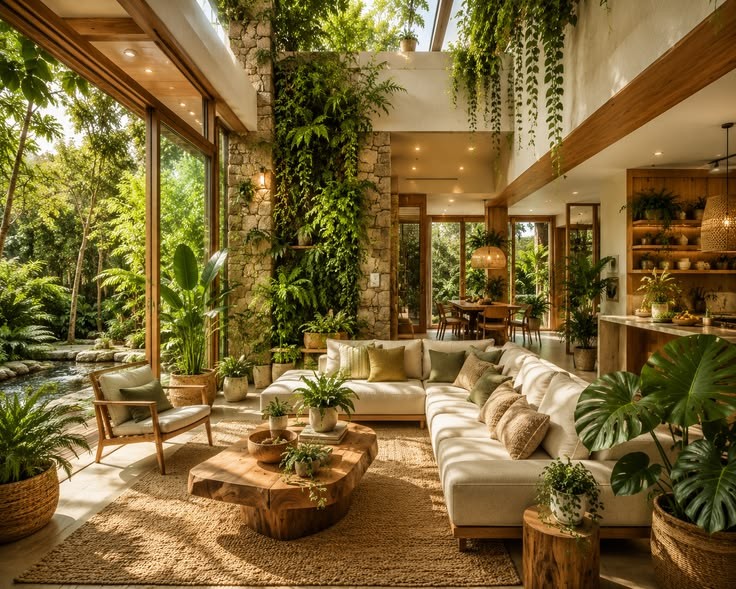
The term was popularized by the biologist E. O. Wilson, who argued that humans have an innate attraction to the natural world, and later translated into architecture by researchers Stephen Kellert and Elizabeth Calabrese in their 2015 framework of 14 patterns. You don’t need the framework memorized. You need the working version: bring in living plants, maximize natural light, use real materials, create small surprises, and give every room at least one honest connection to the outdoors. Done well, the payoff is measurable. Studies of biophilic interiors have recorded drops in reported stress, faster recovery from fatigue, and — in workplace studies — measurable gains in creativity and concentration. Your home deserves the same treatment your best employers already give their offices.
This guide walks through the whole house, room by room, with concrete numbers: how much light a plant actually needs, what humidity levels keep a bathroom garden alive, how far to hang a mirror from a window to double its light. None of it requires a renovation. Most of it requires a Saturday, a hardware store, and the willingness to let one corner of your house get a little wilder.
Start With Light: The Cheapest Biophilic Upgrade in the House
Before you buy a single plant, audit your light. Biophilic design begins with daylight because light is the resource everything else depends on — your plants, your mood, your sleep cycle. Stand in each room at 9 a.m., noon, and 4 p.m. on a clear day and simply note which corners go dark. Those dark corners are where your house is failing you, and they are also where most people make their first mistake: placing a beautiful fiddle-leaf fig in a lightless corner and watching it shed leaves for six months.
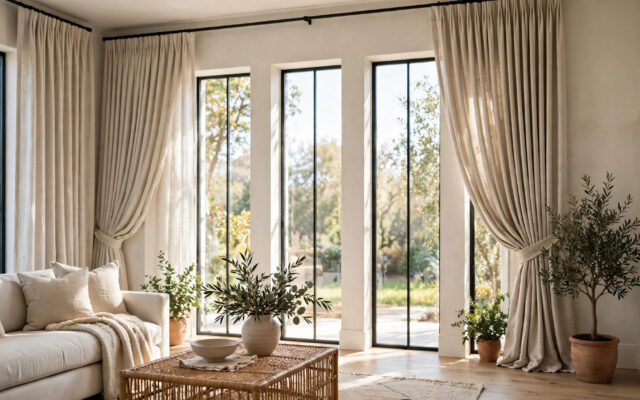
Windows do more than admit light; they frame what Kellert called “visual connection with nature.” If you have a window that faces a parking lot, the answer is not to close the blinds forever. A sheer curtain that diffuses the view, a tall plant placed in the foreground so your eye stops on green before asphalt — these are the small moves that work. For windows with genuinely good views, treat them like artwork: keep the sill clear, hang nothing that competes with the glass, and place your reading chair so the view is the backdrop. People instinctively face views when they relax; a living room arranged so every seat has a line of sight to the best window will feel calmer than one arranged around a television, even if the furniture is identical.
Where windows are scarce, borrow light aggressively. A mirror hung on the wall perpendicular to a window — not opposite it, which just glares — can throw usable daylight 10 to 15 feet deeper into a room. Pale, warm-white walls with a light reflectance value above 70 bounce light instead of swallowing it. And in hallways or bathrooms with no window at all, a full-spectrum bulb in the 5000–6500K range, run on a timer to follow daylight hours, gives plants and people alike a believable imitation of the sun. It is not a perfect substitute, but in a windowless powder room it is the difference between a cell and a garden nook.
The Living Room: Layer Green at Three Heights
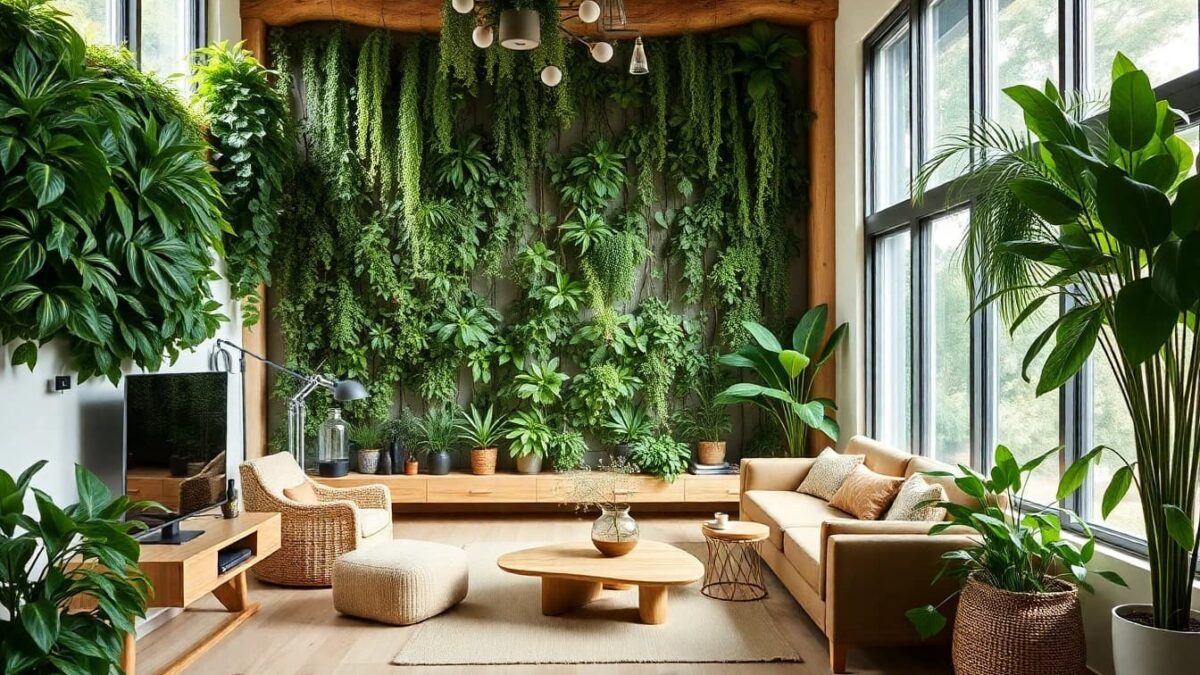
The living room is where biophilic design pays off most visibly, because it is the room you sit in the longest. The professional trick is layering vegetation at three heights — floor, table, and hanging — so the eye reads “habitat” rather than “decorated shelf.” One tall plant in a corner (a 5-to-6-foot fiddle-leaf fig, bird of paradise, or kentia palm in a 12-to-14-inch pot) anchors the floor level. Two to three medium plants on side tables and the console behind the sofa fill the middle. One trailing plant — pothos, philodendron, or string of pearls — spilling from a high shelf or hanging planter completes the canopy effect.
That sounds like a lot of plants, but the math is friendlier than it looks. A room of 200 square feet reaches a visibly “green” threshold at about 6 to 8 plants of mixed sizes, and maintenance collapses if you choose for your conditions instead of your fantasies. Low-light living rooms (north-facing windows, or windows more than 8 feet from the seating area) want ZZ plants, snake plants, and cast-iron plants — all of which survive on 50 to 100 foot-candles and forgive a missed watering by two weeks. Bright living rooms can host the dramatic stuff: monsteras, birds of paradise, olive trees. The single most useful tool is a $15 moisture meter, because overwatering kills roughly ten times more houseplants than underwatering. Stick to one watering day a week, check the meter, and you will outperform 90 percent of plant owners.
Beyond plants, the living room gets biophilic texture: a jute or sisal rug underfoot, a throw in undyed wool, a side table in solid oak or walnut instead of lacquered MDF. The human hand can detect the difference between real wood grain and a printed imitation in about three seconds of touch — the grain has depth, temperature variation, tiny imperfections that printed surfaces can’t fake. You don’t need to replace all your furniture. One honest material per room, touched daily, does the perceptual work.
The Kitchen: Grow Something You Can Eat
The kitchen is the easiest room in which to be biophilic and the easiest to get wrong, because it already generates the two things plants hate: heat spikes and grease film. A basil plant on the windowsill above the sink is the classic move, and it works precisely because it’s within arm’s reach of the cutting board — you will actually water it, and you will actually use it. Scale the idea: a south- or west-facing window can support a row of four to six herbs (basil, thyme, rosemary, mint in its own pot — mint will strangle its neighbors — chives, and parsley). In a 4-inch pot each, they’ll supply a two-person household with fresh herbs for most of the year at a total setup cost under $40.
No sunny window? A full-spectrum LED grow light on a timer, 14 to 16 hours a day, turns a dark kitchen corner into a herb station. Modern LED panels draw 20 to 40 watts — pennies a day — and herbs under them grow faster than on most windowsills. Mount the light 6 to 12 inches above the plants and raise it as they grow; the single failure mode is hanging it three feet up like a pendant, where the light intensity drops to uselessness.
The kitchen also benefits from nature’s patterns in a subtler way: the fractal complexity of a butcher-block counter, the veining of a marble or quartzite backsplash, a bowl of actual fruit on the island instead of a decorative orb set. Fruit in a bowl is the oldest biophilic centerpiece in existence — it signals abundance, it changes with the seasons, and unlike fake lemons it eventually gets eaten and replaced, which keeps the composition alive.
The Bedroom: Design for Darkness, Dawn, and Clean Air
The bedroom asks something different of biophilic design than any other room: it must help you fall asleep and wake up. That means the plant strategy shifts. The old myth that bedroom plants “steal your oxygen” at night is quantitatively silly — a dozen plants consume less oxygen overnight than one sleeping human exhales in an hour — but the bedroom does favor low-maintenance, sculptural plants that don’t demand attention: snake plants, ZZ plants, a single peace lily on the dresser. Keep the count modest, three to five plants, so the room reads restful rather than greenhouse.
Light is the real lever here. Blackout capability for sleep, plus a dawn-simulating alarm or simply curtains you can throw open, gives your circadian system the two signals it evolved to expect: real darkness, then real light. If your bedroom faces east, skip the sunrise lamp — the actual sun is free and better. If it faces north or a light well, a dawn simulator that ramps from 0 to 300 lux over 30 minutes measurably eases waking in winter months, and it costs less than a single tank of gas.
Materials matter most where skin meets surface. Cotton or linen bedding in the 200–400 thread-count range breathes better than high-thread-count sateen, which can trap heat. A wool rug beside the bed instead of cold hardwood under bare feet at 6 a.m. is a small biophilic luxury with an outsized effect on how the morning feels. And keep one window operable if you can — five minutes of open-window air before bed drops CO₂ levels that build up overnight in a sealed room, and the faint sounds of the outside world (distant traffic, wind, a night bird) are the auditory equivalent of a landscape painting.
The Bathroom: Your Home’s Secret Greenhouse
Bathrooms are paradoxically the best plant rooms in most houses. Showers generate humidity in the 60–80 percent range — tropical conditions that ferns, orchids, calatheas, and air plants find luxurious. The constraint is light, so the winning formula is humidity-loving plants plus whatever light you can engineer. A frosted window is ideal: bright, diffused, private. No window? A 15-watt full-spectrum bulb in the vanity fixture, left on 8 to 10 hours a day, sustains ferns and pothos indefinitely.
The design move that elevates a bathroom from functional to restorative is material honesty: stone, wood, and water, the three oldest building materials, in deliberate combination. A teak bath mat (naturally antimicrobial, warm underfoot) instead of a fabric one that stays damp. A live-edge wooden stool holding folded towels. River stones in the bottom of a glass vase. These are $20 decisions that change the room’s entire register. Avoid the common trap of the “spa bathroom” that achieves calm through sterility — all white, all smooth, nothing alive. True biophilic calm has texture: veined stone, grained wood, a fern’s fractal fronds against tile.
One caution: bathrooms punish the wrong plants fast. Succulents and cacti rot in shower humidity within weeks. Lavender mildews. Match the plant to the microclimate — ferns and orchids for steamy bathrooms, snake plants and ZZ for dry powder rooms — and the “secret greenhouse” maintains itself with almost no intervention.
The Home Office: Nature as a Focus Tool
Your desk is where biophilic design stops being decorative and starts being performance equipment. The research here is unusually consistent: workers with a view of nature or even a few desk plants report lower stress and score higher on attention tasks, with some studies finding creativity gains in the 10–15 percent range. The mechanism isn’t mystical — natural scenes give the directed-attention system micro-rest breaks, the visual equivalent of looking up from a screen every twenty minutes.
The practical setup: position your desk perpendicular to a window so you get daylight without screen glare, and keep one plant inside your peripheral vision — a small pothos or fern at the desk’s left or right edge, close enough that its leaves occasionally catch your eye when you look up. A second, larger plant behind you completes the sense of enclosure; humans concentrate better with something green at their backs, a leftover preference from avoiding predators that now just reads as “safe.”
Sound is the overlooked biophilic channel in offices. A small tabletop fountain ($25–$50, recirculating, nearly silent pump) adds moving water — one of the strongest calm signals in the biophilic pattern set — and its burble masks household noise better than white-noise apps because the brain categorizes it as non-threatening. If a fountain feels like too much, even a 10-minute loop of forest or stream audio at low volume during deep-work blocks measurably lowers reported tension. The office doesn’t need to look like a jungle. It needs one living thing in view, real daylight, and ideally the sound of water.
Hallways, Stairs, and Forgotten Corners: The Connective Tissue
Biophilic design fails when it stops at the living room door. The transitional spaces — hallways, stairwells, landings, the weird triangle under the stairs — are where a house either feels like one continuous habitat or a series of decorated boxes. These spaces share two traits: poor light and high traffic. The plant answer is the toughest species you own: snake plants, ZZ plants, and pothos tolerate the 25–50 foot-candles of a typical interior hallway and survive the occasional bump from a laundry basket.
Where plants can’t go, pattern goes. A runner rug in a leaf or wave motif, wallpaper with a botanical print on one hallway wall, a gallery of framed pressed leaves or black-and-white tree photography — these are representations of nature, and the research suggests they deliver a meaningful fraction of the benefit of the real thing. The key is scale and authenticity of feeling: one large botanical print (24 by 36 inches or bigger) reads as a window; twelve tiny ones read as clutter.
Stairwells deserve special mention because they often contain the tallest uninterrupted wall in the house — a perfect site for a vertical element. A wall-mounted planter system with trailing pothos, a tall narrow mirror that bounces light down the stairwell, or simply a skylight if you’re renovating: verticality itself is a biophilic pattern (think forest canopy, cliff faces), and a stairwell that draws the eye upward feels larger and more alive than one that doesn’t.
Materials and Maintenance: Keeping It Alive Without a Second Job
The graveyard of biophilic intentions is filled with dead ferns and good resolutions. The system that prevents it has four parts, and none takes more than an hour a month. First, consolidate watering to one scheduled day — Sunday morning, say — and walk the house with a moisture meter, watering only what reads dry. Second, group plants by thirst: the weekly drinkers (ferns, calatheas, peace lilies) in the bathroom and kitchen where you’ll see them; the monthly drinkers (snake plants, ZZ, succulents) in the hallway and office where you’ll forget them. Third, accept seasonal rhythm — most houseplants barely grow from November to February and need half the water; the number-one winter killer is continuing the summer schedule.
Fourth, budget for replacement without guilt. Even professionals lose 10 to 20 percent of their houseplants a year. A $60 annual “plant replacement fund” — one trip to the nursery each spring — keeps the whole system lush without the shame spiral of the dead monstera. Buy small: a $8 four-inch pothos becomes a six-foot trailer in eighteen months, while a $80 mature specimen arrives stressed from the greenhouse and often declines. Young plants adapt to your house; mature plants mourn the nursery.
On materials, the maintenance rule is equally simple: choose surfaces that age gracefully. Solid wood develops patina; veneer peels. Natural stone stains beautifully; cultured marble just stains. Linen wrinkles elegantly; cheap polyester pills. Biophilic design is fundamentally about the honest aging of real things — a house that looks better at year five than at move-in is the ultimate proof the approach is working.
This article was produced with the assistance of AI.