Stand in front of any bare window for a week and you’ll learn exactly what it does wrong: the 6 a.m. sun blasting the bedroom, the neighbor’s kitchen visible from your sofa, the living room that turns into a greenhouse every July afternoon. Window treatments fix all three problems at once — light, privacy, and heat — but the showroom wall of samples is genuinely confusing. Blinds, shades, and shutters all cover glass, all come in white, and all get described by salespeople as “perfect for your space.” They are not interchangeable. Each one is a different machine for managing light, with different costs, lifespans, and failure modes.

This guide cuts through the showroom talk. You’ll get honest price ranges (installed, per window, in 2026 dollars), the rooms where each option shines and the rooms where it quietly fails, and the maintenance reality nobody mentions until year three. By the end you’ll be able to walk into any window-covering store, ignore the upsell script, and order exactly what your house needs.
What Each One Actually Is (and Isn’t)
The confusion starts with vocabulary, so let’s fix that first. Blinds are hard slats — wood, faux wood, aluminum, or vinyl — connected by cords or ladders, and they tilt. That tilting is the whole point: you can angle slats to bounce daylight onto the ceiling while blocking the direct view in, a trick neither shades nor shutters replicate as precisely. Shades are a single piece of soft material — fabric, woven wood, or cellular honeycomb — that rolls, folds, or stacks up and down. They don’t tilt; they filter or block. Shutters are solid panels with louvers inside a frame, hinged to the window casing like a door. They’re furniture-grade, permanent, and the most expensive of the three by a wide margin.
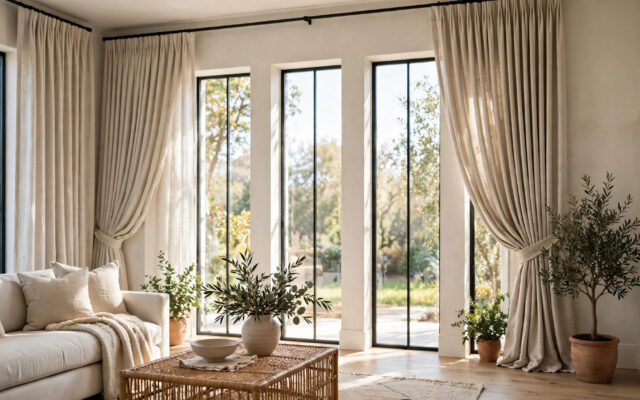
People also conflate these with curtains, which are a separate layer entirely — fabric panels on a rod that stack to the sides. Curtains and any of the three hard treatments combine beautifully (shutters plus linen curtain panels is a classic for a reason), but this guide compares the three hard options against each other, since that’s the decision most homeowners actually face: pick one mechanism per window and live with it for a decade.
Blinds: The Precise, Affordable Workhorse
Blinds are the default for a reason: they do the most per dollar. A standard 36-by-60-inch vinyl blind costs $25 to $60 off the shelf; real wood runs $80 to $180 per window; installed custom blinds of any material land around $100 to $300 per window. Nothing else gives you this much light control this cheaply. Tilt the slats up and daylight washes the ceiling while the street sees nothing. Tilt them down and the room goes dim at noon. Raise them fully and the window disappears.
The material choice matters more than the brand. Real wood blinds look warm and rich — and they warp. In bathrooms, kitchens, or any window that collects condensation, wood slats will cup and twist within two to three years; faux wood (a PVC composite) looks 90 percent as good and survives steam indefinitely. Aluminum mini-blinds are the cheapest option and the ugliest aging one: they dent, they tangle, and the cords yellow. If budget forces aluminum, spend the extra $15 per window for the 2-inch slat version over the 1-inch — the proportions look intentional instead of institutional.
Blinds’ weaknesses are maintenance and cords. Every slat collects dust on both faces, which means a 12-slat blind has 24 dusty surfaces per window. In a house with ten windows, that’s a real chore — plan on a twice-yearly wipe-down with a damp microfiber cloth or a vacuum brush attachment, about 20 minutes for the whole house once you have the rhythm. Cord safety is the serious issue: pre-2018 corded blinds are a strangulation hazard for small children and pets, and the industry has moved to cordless as standard. If your home has kids under six, cordless isn’t optional — it’s the only responsible choice, and it adds roughly $20 to $40 per window.
Shades: Soft Light, Clean Lines, Best Insulation
Shades are what you buy when you want the window to look soft and the room to feel calm. Roller shades ($50–$150 installed per window) are the minimalists’ choice: a flat sheet of fabric that vanishes into a cassette at the top. Roman shades ($100–$300) fold into soft horizontal pleats and read as tailored and traditional. But the engineering star of the category is the cellular (honeycomb) shade, $80–$250 per window, whose trapped-air pockets genuinely insulate. In independent testing, double-cell cellular shades cut heat loss through a window by up to 40 percent and reduce solar heat gain by up to 60 percent when closed — numbers that translate to a noticeable difference on winter heating bills for a house with large or numerous windows.
Light-filtering versus blackout is the key shade decision, and it’s room-specific. Light-filtering fabrics glow — they turn harsh sun into soft ambient light while preserving privacy during the day (at night, with lights on inside, silhouettes show through; plan accordingly). Blackout shades, with their foam or foil backing, block 99 percent of light and are the correct choice for bedrooms, nurseries, and media rooms. The common mistake is putting light-filtering shades in a bedroom and then wondering why the 5:30 a.m. summer sunrise still wakes you. Match the opacity to the room’s job.
Woven wood (bamboo, grass, matchstick) shades deserve their own note because they sit at the intersection of two trends: natural texture and light control. They’re beautiful — warm, organic, quietly expensive-looking at $120–$350 per window — and they filter light into dappled patterns that flatter every room. Their limitation is privacy: the weave has sight lines, so they need a privacy liner (add $30–$60 per window) in bedrooms and street-facing rooms. Without the liner they’re a living-room-only product.
Shade maintenance is the easiest of the three categories: vacuum with a brush attachment twice a year, spot-clean fabric stains immediately, and that’s it. The failure mode is mechanical — cords and clutches wear out. Budget for a 7-to-10-year lifespan on daily-use shades, and buy from manufacturers with real warranties (Hunter Douglas, Bali, and Levolor all warranty mechanisms for life in most lines) rather than no-name imports whose replacement parts don’t exist in year four.
Shutters: The Permanent, Premium Choice
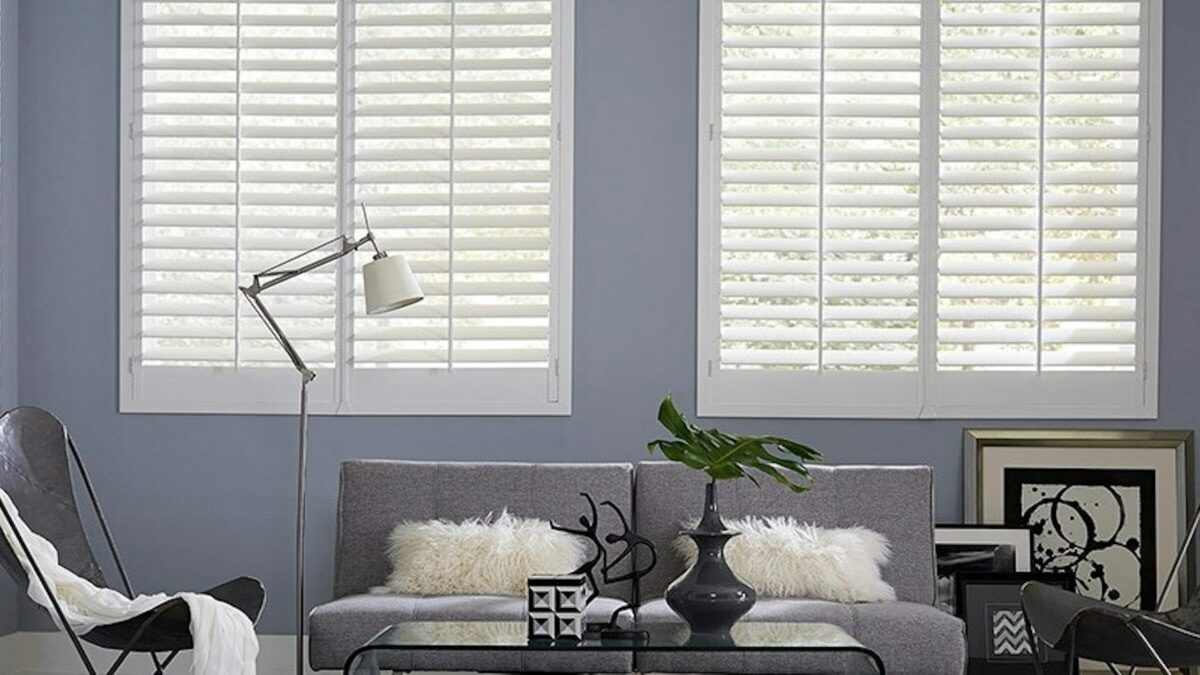
Plantation shutters are the only window treatment that’s also a home improvement in the appraisal sense. Solid wood or poly-resin panels, custom-built to the window, hinged in a frame — they read as architecture, not decoration. Installed cost runs $300 to $800 per window, two to four times the price of quality blinds, and that’s the number that ends most conversations. But the math changes if you think in decades: shutters last 25-plus years with essentially no maintenance beyond dusting, while blinds get replaced two or three times in the same span. Over 25 years, $500 shutters cost $20 a year; three rounds of $150 blinds cost $18 a year. The premium is real but smaller than the sticker suggests.
Shutters’ functional advantage is durability plus a particular kind of light control. The louvers tilt like blind slats, but the panels themselves also swing open — you get three states (closed, tilted, open) instead of two, and the open state exposes the full window for cleaning and maximum view. They’re the best choice for wide or tall windows where blinds would need multiple panels with visible gaps, and for street-level windows where you want the top louvers open for light while the bottom stays closed for privacy — the classic café-style configuration.
The material decision is binary: real hardwood (basswood, poplar) for dry rooms where you want the richest look, or solid poly-resin for bathrooms, kitchens, and humid climates where wood warps. Poly shutters have closed the aesthetic gap substantially — from three feet away even professionals struggle to tell — and they carry the stronger warranty. One caution: shutters are heavy. A 72-inch-wide shutter panel needs a mid-rail for structural support and proper hinging, which is why this is a professional-measure, professional-install product. DIY shutter installation is where good money goes to die; the measuring tolerances are eighths of an inch, and a mismeasured panel can’t be trimmed.
Room-by-Room: What Goes Where
General principles only get you so far — windows live in rooms, and rooms have jobs. Here’s the cheat sheet that resolves 90 percent of real decisions:
- Bedrooms: Blackout cellular shades or blackout roller shades, cordless. Sleep quality is the job; light leakage is the enemy. Add curtain panels on the sides if you want softness — the shade does the work, the curtains do the looking.
- Living rooms: Faux-wood blinds or woven wood shades with liners. You want daytime light control with view preservation, and these tilt or filter while keeping the room bright.
- Kitchens and bathrooms: Faux-wood blinds or poly shutters only. Real wood, real bamboo, and fabric shades all die young in steam and grease. Cordless or top-down/bottom-up for privacy above the sink.
- Home offices: Light-filtering cellular or roller shades. Glare control without cave-darkness — you need to see the screen and stay awake.
- Street-facing ground floors: Shutters (café-style or full) or top-down/bottom-up shades. Privacy from the sidewalk with light from the sky is the specific problem; these are the specific solutions.
- Sliding glass doors and wide openings: Vertical cellular shades or panel-track blinds. Standard horizontal products don’t span 8-foot openings gracefully.
Consistency matters more than perfection: using one treatment type throughout a home’s public spaces (all faux-wood blinds, say) looks intentional and keeps costs down through bulk ordering, while mixing all three types room by room can look disjointed from the curb — an underrated consideration, since mismatched window treatments are visible from the street and subtly cheapen a home’s exterior.
The Money Math: Cost, Energy, and Resale
Let’s put real numbers on a typical 2,000-square-foot home with 12 windows. Budget vinyl blinds throughout: $400–$700 installed, replaced every 5–7 years. Mid-range faux-wood blinds or cellular shades: $1,500–$3,000, lasting 8–12 years. Plantation shutters throughout: $4,000–$8,000, lasting 25+ years. All three are legitimate choices at different budget points — the mistake is mixing tiers awkwardly, like $50 vinyl blinds in a kitchen with $15,000 of new cabinets. Match the treatment tier to the room’s finishes and the whole house feels coherent.
Energy is the hidden line item. The Department of Energy estimates that 76 percent of the sunlight hitting standard double-pane windows becomes heat inside the home, and that well-chosen window treatments can cut that heat gain substantially — cellular shades lead, followed by reflective roller shades, with standard blinds trailing. In hot climates, exterior treatments (awnings, solar screens) outperform all interior options, but among interior choices the ranking is clear: if your summer cooling bills are the pain point, cellular shades are the rational buy even before you consider how they look.
On resale, appraisers consistently treat plantation shutters as a value-add — they’re fixtures, they photograph beautifully, and buyers read them as “done.” Blinds and shades are generally considered personal property that conveys or doesn’t; they neither add nor subtract much. If you’re selling within two years, shutters in the main living areas are one of the few window investments with a plausible return; if you’re staying, buy for your own daily comfort and let resale be a bonus.
Measuring, Ordering, and the Mistakes Everyone Makes
Eighty percent of window-treatment regret is measurement error, and the fix is a steel tape measure and ten unhurried minutes per window. Measure width in three places (top, middle, bottom) and use the narrowest for inside mounts; measure height in three places and use the longest. Write down width first, always — the industry convention is width × height, and reversing them is the classic $200 mistake. For inside mounts, subtract nothing; manufacturers take their own deductions. For outside mounts, add 2 to 3 inches per side so the treatment covers the trim and blocks light gaps.
The mistakes list, compiled from installer war stories: ordering real wood for a bathroom window (warps by year two); choosing light-filtering shades for a nursery (the baby wakes at dawn all summer); corded blinds with toddlers in the house (safety, full stop); measuring once, quickly, on a ladder, while distracted (the $200 reversal); and the most common of all — buying the cheapest option for the most-used room. The living room blinds get touched daily for a decade. That’s the window to spend on, not the guest bedroom’s.
Motorization and Smart Features: Worth It or Gimmick?
Motorized window treatments — blinds and shades that raise, lower, and tilt via remote, app, or voice — have dropped dramatically in price. A decade ago motorization added $300+ per window; today retrofit motors run $80 to $150 per window and integrated motorized shades start around $200. The question is whether the convenience justifies the cost and the battery changes (most run on rechargeable batteries needing a charge every 6 to 12 months, or hardwired power for new construction).
The honest answer: motorize the windows you can’t reach, and skip the rest. Skylights, windows behind bathtubs, and 8-foot sliders are genuinely better motorized — the alternative is a long pole you never use, which means the treatment stays in one position forever. For standard reachable windows, manual cordless operation takes four seconds and never needs charging. The exception is the “scene” use case: programmed schedules that lower west-facing shades at 3 p.m. every summer day genuinely cut cooling loads, and voice control (“close the bedroom shades”) is a real accessibility win for elderly or mobility-limited users. Buy motorization for function — hard-to-reach windows, scheduled energy savings, accessibility — not for the novelty, which wears off around week three.
Cleaning, Repair, and Knowing When to Replace
Every treatment type has a maintenance rhythm, and knowing it prevents the slow decline that makes windows look tired. Blinds: dust monthly with a microfiber cloth or vacuum brush (two minutes per window), deep-clean yearly by wiping slats with a damp cloth and mild soap. Fabric shades: vacuum twice yearly, spot-clean stains immediately with a barely-damp cloth — never saturate fabric shades, which water-spot permanently. Shutters: dust with a dry cloth; the painted or poly finish wipes clean with a damp cloth. None of these take long; the failure is never doing them until year four, when the grime has bonded.
Repairs are more feasible than most people think. Broken blind slats can be replaced individually ($2–$5 per slat from the manufacturer if you have the model number). Frayed cords on older blinds are replaceable with $10 restring kits and a YouTube tutorial, though at that point upgrading to cordless is often smarter. Shade mechanisms under warranty get free replacement parts — keep your order paperwork. The replacement signal is functional, not cosmetic: when slats won’t stay tilted, when shades won’t stay up, or when the mechanism needs coaxing daily, the treatment has retired. Cosmetic yellowing or one broken slat is a repair; systemic mechanical failure across multiple windows is a replacement order.
Finally, a word on timing: custom treatments take 2 to 6 weeks from order to installation, longer in spring when everyone renovates at once. If you’re moving into a new home, order in week one and live with temporary paper shades ($5 each, surprisingly decent) until the real ones arrive. Your windows — and your sleep, your privacy, and your cooling bill — will thank you for getting this decision right instead of getting it fast.
This article was produced with the assistance of AI.